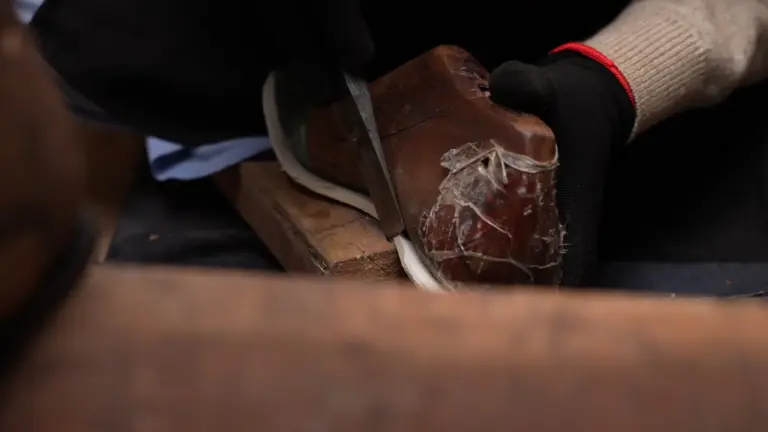
Leather Skiving in Shoemaking — Why the Edges of an Upper Are Thinned
Skiving is one of the quiet operations that affects how refined an upper looks. It reduces bulk where leather pieces need to fold, overlap or join.
Skiving is controlled reduction, not random thinning. The goal is enough material for strength with less bulk where pieces meet.
Skiving is the controlled thinning of leather, usually near an edge.
In shoemaking it helps pattern pieces fold, overlap and stitch together without creating unnecessary bulk.
Where is leather skived?
Common areas can include:
- folded top lines
- seam overlaps
- lining edges
- toe or heel reinforcement transitions
- decorative folded edges
The exact skiving pattern depends on the upper design and leather thickness.
Why not just use thinner leather?
A shoe upper needs sufficient body across the main panel, but the same full thickness can become bulky where two or three layers meet.
Skiving lets the shoemaker keep the main panel thickness while selectively reducing material at the join.
Hand skiving vs machine skiving
Skiving can be done with a sharp hand knife or specialized machinery.
Neither method is automatically superior. The important variables are consistency, taper, location and avoiding damage to the useful leather fibers.
What happens if leather is over-skived?
Removing too much material can create a weak edge that stretches, tears or prints through the finished upper.
The aim is a gradual controlled taper, not the thinnest possible edge.
How does skiving affect appearance?
Cleaner folds and flatter seam transitions can make an upper look more refined.
It also helps keep lining and reinforcement from producing visible ridges where they end.
Does every upper use the same skiving?
No.
A thick waxy Derby, fine calf Oxford, suede loafer and boot can require different edge treatment. Pattern construction and whether an edge is raw, folded or bound also change the operation.
That is why Handsole’s product-specific approach matters: the visible style does not reveal every internal upper operation.
Where does skiving sit in the process?
Skiving belongs to upper preparation and closing—the set of operations that turns cut pattern pieces into a complete upper before lasting.
See How a Pair Is Built for the full sequence.
Skiving and seam design
A designer and closer plan seam construction together. A folded edge may need a gradual skive so the fold lies flat. An overlap seam may thin one piece more than another. Reinforcement may need a feathered transition so its edge does not print through the upper.
These decisions are small individually, but a formal upper contains many edges. Consistency across them is part of what makes the finished shoe look controlled rather than bulky.
Common questions
Can suede be skived?
Yes, but the material behaves differently from smooth leather and the nap can make thickness judgment less visually obvious. The operation still needs to preserve enough strength for the seam.
Why are some raw edges not skived?
Some patterns intentionally expose full-thickness or painted edges. Skiving is used where the construction needs it, not simply because an edge exists.
Deeper considerations
Skiving has both width and depth
A good skive is not merely “thin at the edge.” The operator controls how far the taper extends into the piece and how gradually thickness is removed. A short abrupt skive can create a ridge; an overly long deep skive can weaken too much material.
Different seam types need different skives
A folded edge, underlay seam and turned seam each place leather layers differently. The skive is planned around that geometry so the final stack has the intended thickness.
Lining skiving is especially delicate
Lining leather is already thin. Removing too much can cause tearing during lasting or wear. The goal is just enough reduction to prevent a hard ridge where lining pieces overlap.
Knife sharpness is part of process control
A dull blade requires extra force and can tear or compress leather rather than slicing cleanly. Whether done by hand or machine, a sharp controlled cutting edge is essential for consistent feathering.
How over-skiving reveals itself later
Weak edges may stretch around eyelets, tear near seams or show a visible hollow after lasting. Because these failures can appear after later operations, good skiving is a form of preventive quality control.
Why customers rarely see the operation
Most of the evidence disappears inside folded seams and lining. That makes skiving a useful example of craftsmanship that matters to the finished result without needing to be visible as decoration.
What a workshop photograph should show
For educational content, the most useful image is a close view of the leather thickness transitioning toward the edge—not simply a craftsman holding a knife. The visual should explain the operation.
Skiving around broguing and decorative pieces
Decorative layers can create extra thickness where medallions, wing pieces or facings overlap. Selective skiving helps those designs remain crisp instead of becoming visibly bulky around seams.
Machine setup matters
A bell-knife skiving machine can be adjusted for width, depth and feed. Consistency depends on setup as much as speed. A poorly adjusted machine can remove too much leather just as easily as an inexperienced hand knife.
Why skiving affects lasting
Bulky overlapping edges resist smooth shaping over the last. Well-prepared transitions let the upper pull evenly and reduce the chance of hard ridges showing after lasting.
The practical rule
Skiving is controlled thickness management. When done well it reduces bulk without sacrificing the strength needed at the edge or seam.