Handmade Leather Shoes — What “Handmade” Actually Means
“Handmade” can describe very different shoes. Learn which stages may actually involve handwork, where machines belong, and why construction, leather, last and finishing matter more than the label alone.

Handmade is useful only when the actual operations are clear.
“Handmade leather shoes” sounds like a precise description.
It is not.
Two shoes can both be described as handmade while being produced in very different ways. One may involve extensive hand-lasting, hand-welting, bottom work and finishing. Another may combine manual operations with sewing machines, presses, sanders or mechanized construction.
That does not automatically make one honest and the other dishonest.
The useful question is not simply:
Was this shoe handmade?
It is:
Which parts were done by hand, how was the shoe actually constructed, and what does that change for the finished pair?
If you want to see how the stages fit together in Handsole’s own workshop model, start with Our Craft.
Handmade does not mean tool-free
Shoemaking has always involved tools.
A craftsperson may use knives, awls, hammers, pincers, rasps and brushes. Modern workshops may also use sewing machines, presses, sanding equipment and other powered tools.
The existence of a machine does not by itself tell you whether a shoe involved skilled handwork.
For example, an upper can be assembled on a sewing machine while the person operating it still controls alignment, tension, curves and placement of each seam.
Likewise, a sole edge may be shaped using powered equipment and then refined manually.
The Victoria and Albert Museum’s documentation of traditional bespoke shoe making shows why the word handmade cannot sensibly mean “made without tools.” Shoemaking is a sequence of skilled operations, each using the tools appropriate to the task.
The more useful distinction is where the maker is actively controlling the work and which operations determine the shoe’s structure.
Where handwork can matter
A leather shoe passes through many stages before it becomes a finished pair.
Some affect appearance. Others determine fit, structure or repairability.
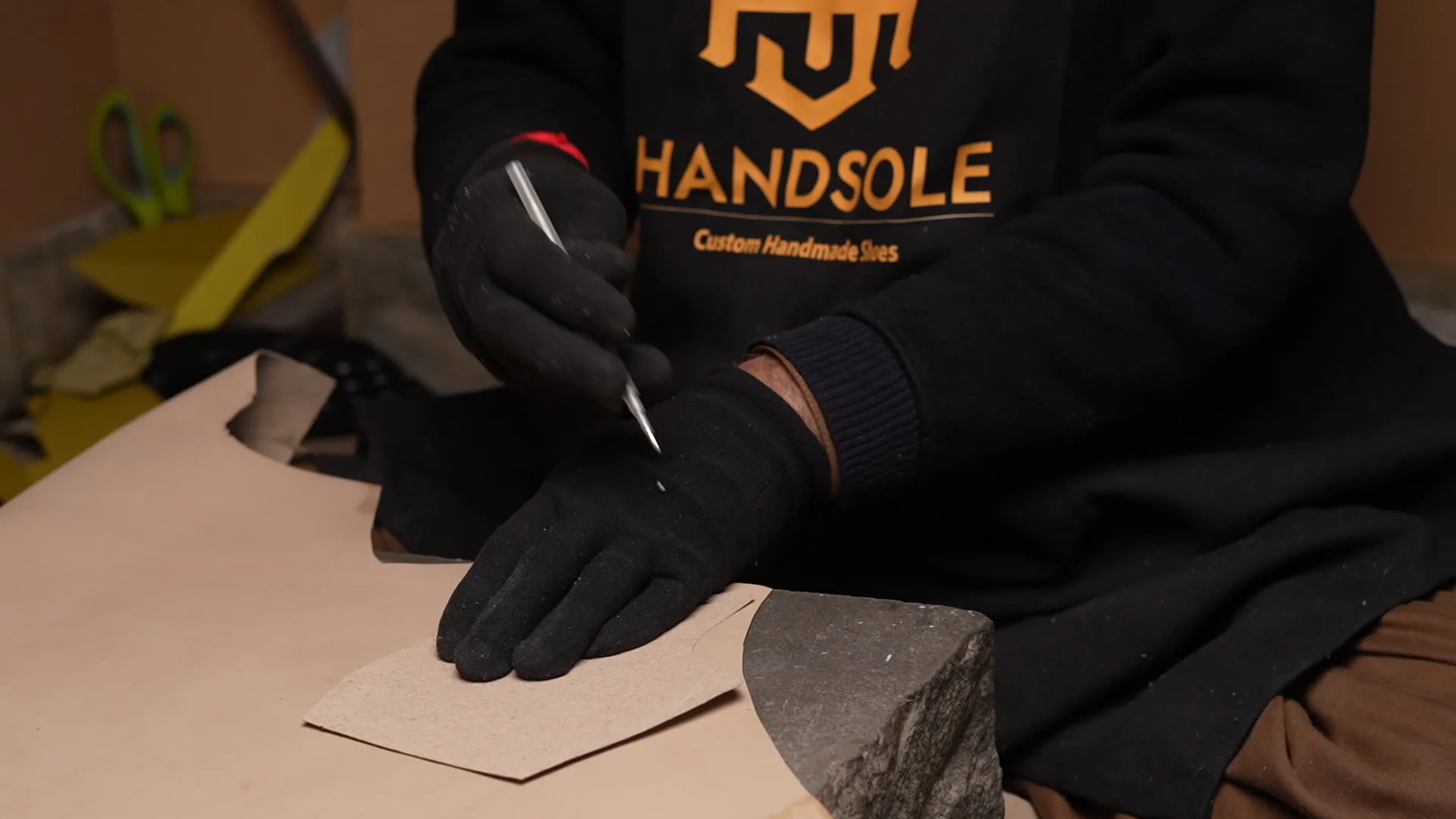
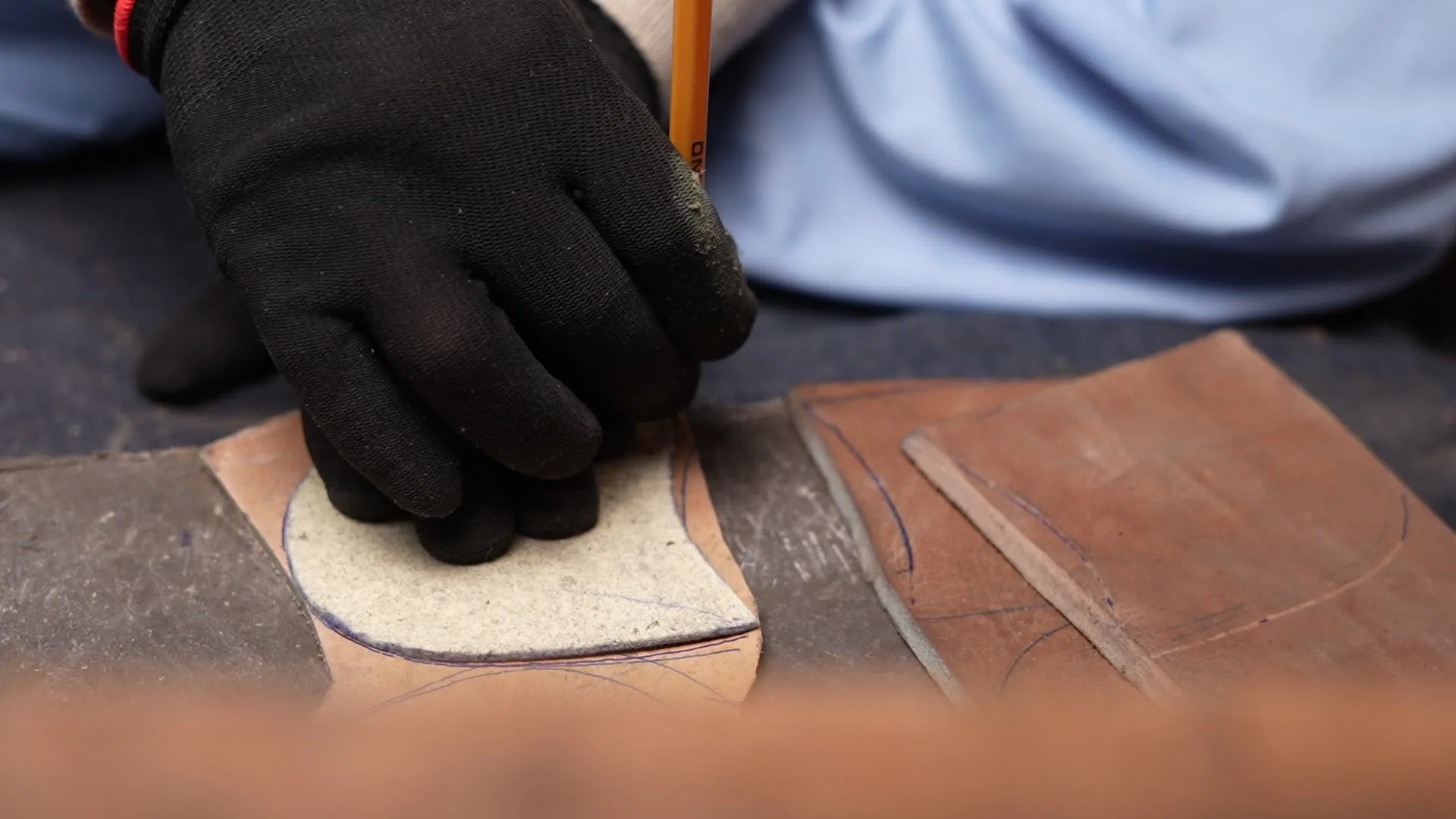
Pattern and leather cutting
The upper begins as pattern pieces.
Those pieces may be cut manually or with cutting equipment, but good clicking still depends on understanding the hide: grain direction, stretch, visible character and which areas are appropriate for each part of the shoe.
A premium leather label cannot compensate for careless cutting.
For a deeper explanation of leather terminology, use the Leather Knowledge Hub rather than treating one grade word as the entire quality story.
Upper closing
The cut leather pieces are assembled into the upper.
Much of modern upper stitching is performed with sewing machines because they provide the control and consistency required for fine seams.
That does not make the entire shoe “machine made.”
It simply means the stitching method should be described accurately rather than implying every stitch was formed by hand.
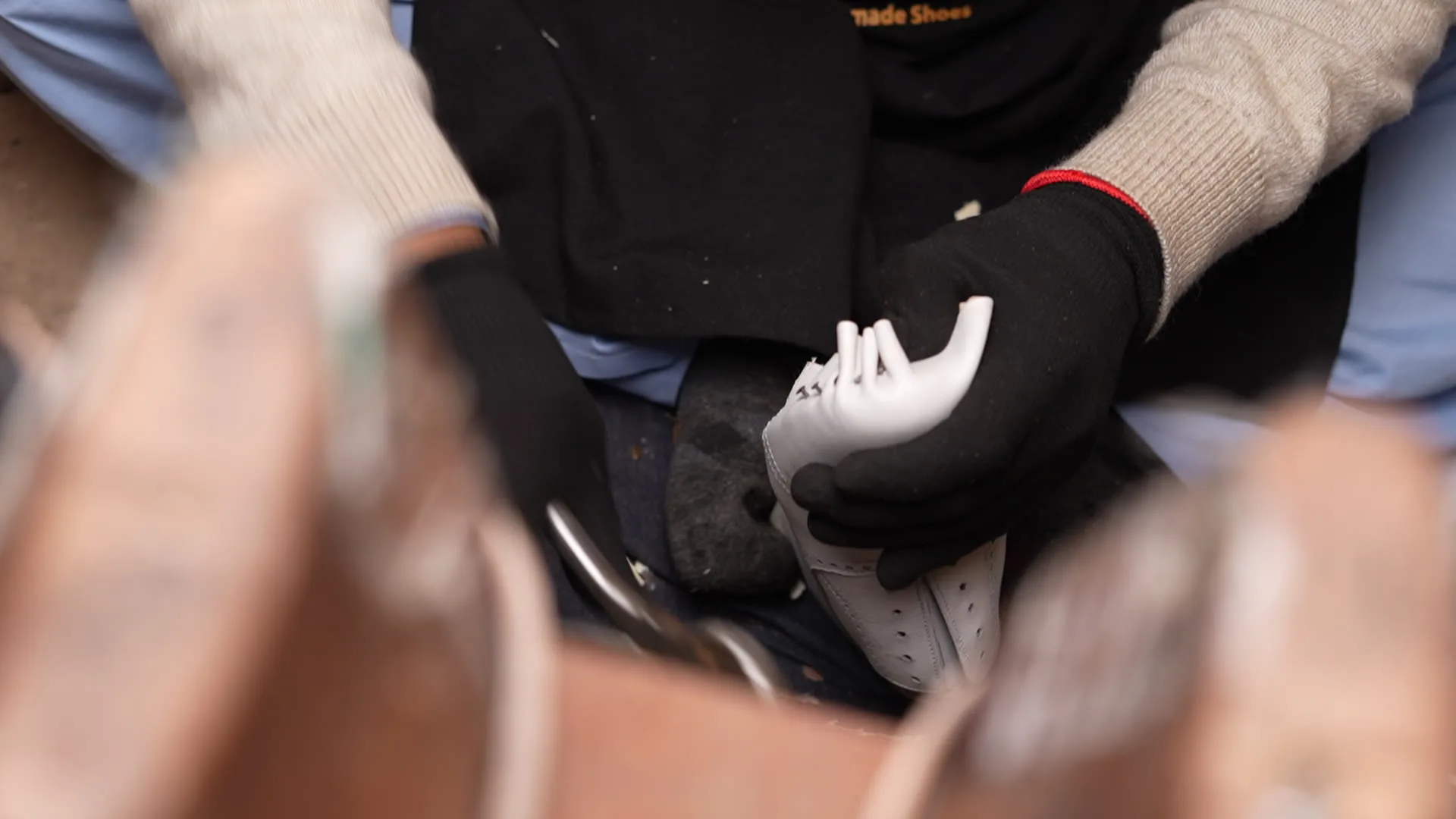
Lasting
Lasting shapes the completed upper around the shoe last.
This is one of the stages where skilled manual control can have a visible and structural effect. The leather must be drawn around a three-dimensional form while controlling tension, alignment and the way the upper sits around the toe, waist and heel.
But careful hand-lasting cannot rescue the wrong last or incorrect size.
The geometry still has to suit the wearer.
Our guide to what a shoe last actually does explains why two shoes with the same marked size can still fit and look very different.
Welting and bottom construction
This is where broad words such as handmade become especially unhelpful.
A shoe can be hand-lasted and still use Goodyear-welted construction.
Another can use a hand-stitched welt.
Another may use Blake construction.
These are not interchangeable descriptions.
If the welt is stitched to the prepared insole by hand, that should be stated specifically.
If the welt is attached by a Goodyear welting machine, that should also be stated honestly.
For the broader anatomy, see Shoe Construction Explained. For the three-way comparison, read Blake Stitch vs Goodyear Welt vs Hand Welt.
Sole and heel work
Bottom work can involve preparing the sole, trimming edges, shaping the waist, building or attaching the heel and finishing the bottom.
How much happens manually varies by maker and by shoe.
Again, the useful information is the actual process—not the assumption that one word applies identically to every pair.
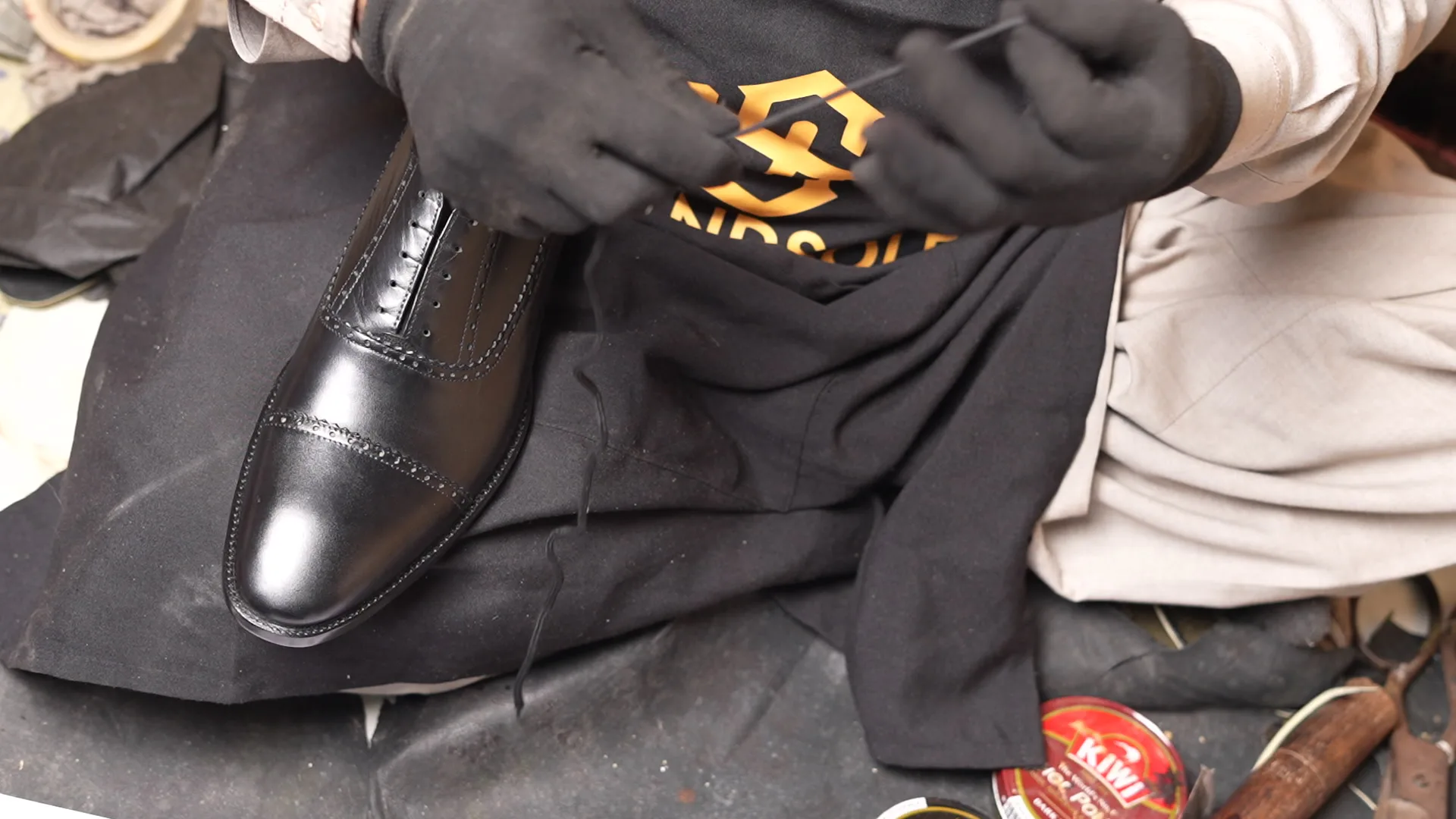
Finishing
Finishing can involve edge work, coloring, polishing, burnishing and tonal development.
Hand finishing can give the maker direct control over subtle variations in color and surface appearance.
But finishing is still only one stage.
A beautifully polished shoe is not automatically a well-constructed shoe.
Handmade is not the same as hand-welted
This is one of the most important distinctions in traditional footwear.
Handmade describes the broader involvement of manual craft.
Hand-welted describes a specific construction operation.
In hand-welted construction, the shoemaker prepares the insole and stitches the welt to it manually.
Goodyear-welted construction mechanizes that welting operation.
That does not make a Goodyear-welted shoe bad. Well-executed Goodyear construction can produce highly serviceable footwear.
The mistake is using the broader word handmade to blur the difference between the two.
If construction matters to you, look for the actual construction name rather than assuming it from the headline.
Handmade cannot rescue the wrong leather
Leather quality and leather suitability are separate from the amount of handwork.
A maker can spend considerable time working with leather that is poorly suited to the shoe.
Likewise, carefully selected leather does not guarantee excellent construction.
What matters is how the decisions work together.
For a shoe upper, useful questions include the leather type, surface and finish, how it was selected, how the pattern was cut from the hide and whether the material suits the intended structure.
If terms such as full grain, top grain and genuine leather are causing more confusion than clarity, use the Handsole Leather Knowledge Hub.
The individual product specification should still tell you what is actually being used on that particular pair.
Handmade cannot rescue the wrong last
The last is the three-dimensional form around which the shoe takes shape.
It controls the underlying geometry of the toe, forefoot, instep, waist and heel.
A maker can execute beautiful handwork around a last that is completely wrong for your foot.
You will still have the wrong shoe.
That is why fit information deserves the same attention as construction.
When evaluating a Handsole shoe, consider US size, width and last together. The Sizing & Fit Guide brings those three decisions together.
Craftsmanship can execute geometry accurately.
It cannot make unsuitable geometry suitable.
Factory-made and handmade are not opposites
It is tempting to imagine footwear production as two separate worlds.
One shoe is handmade by a craftsperson.
The other comes out of a machine.
Real production is more complicated.
Large factories still use people throughout many stages. Small workshops still use machinery. Many respected makers combine traditional hand operations with equipment where it improves consistency or efficiency.
So “uses machines” is not a useful test by itself.
The better questions are about control, construction and disclosure.
Who determines the fit and shape?
How is the upper lasted?
How is the bottom attached?
What materials are used?
Which operations are performed manually?
Can the maker tell you exactly what you are buying?
Those answers reveal much more than an image of a craftsman’s hands beside a shoe.
What should you look for when buying?
A useful handmade-shoe description should become more specific as you get closer to the product.
Look for information about:
- upper leather
- lining
- shoe last
- available size and width
- construction method
- outsole material
- heel construction
- finishing
- repairability where the construction supports it
Be cautious when a product relies heavily on words such as artisan, heritage, handcrafted or luxury but gives very little information about the shoe itself.
Those words can describe a story.
They cannot replace a specification.
How Handsole uses “handmade”
At Handsole, handmade should describe the workshop approach—not function as a universal shortcut for every material or construction claim.
The useful information comes one level deeper.
Each product page should identify the actual leather, lining, sole, construction and fit information for that particular design.
That distinction matters because different shoes can require different materials and construction decisions.
A global statement should not quietly become a specification for every pair.
The same principle applies to the Journal.
An educational article may explain hand-welted construction, Goodyear welting or leather selection, but the construction of the shoe you are considering should come from that product’s specification.
Common questions
Is handmade the same as hand-welted?
No. Handmade is a broad description of how manual craft is involved in production. Hand-welted identifies a particular construction method.
Are machines a sign of lower quality?
Not automatically. Sewing, sanding and other equipment can be appropriate tools. Execution, materials and construction matter more than whether electricity was involved.
Does more handwork always mean a better shoe?
No. Poor leather, unsuitable last geometry, careless pattern work or weak construction are not corrected simply by adding more hand labor.
Are handmade shoes automatically more comfortable?
No. Comfort depends heavily on fit. Size, width, last geometry, upper design and construction all contribute.
Are handmade shoes always resoleable?
No. Repairability depends primarily on construction and the condition of the shoe. Read When Should Leather Shoes Be Resoled? for the maintenance side of the question.
The better question
“Is it handmade?” is a reasonable place to begin.
It just should not be where the investigation ends.
Ask how the shoe is lasted.
Ask how it is constructed.
Ask what leather and lining are actually being used.
Ask which last, size and width you are buying.
And look for a maker willing to answer those questions without hiding behind one impressive word.
Because handmade should describe real work you can understand—not replace the details that tell you whether the shoe itself is worth buying.