What Is Hand Lasting? How a Leather Upper Is Shaped Over the Last
Hand lasting turns a flat stitched upper into a three-dimensional form around the last. It is skilled shaping work, but the label alone does not guarantee fit or quality.
Lasting gives the upper its three-dimensional form. The quality of the result depends on the last, pattern, leather and control of the operation.
Lasting is the stage where a stitched shoe upper is pulled and shaped over the last.
Before lasting, the upper is still a flexible assembly of leather, lining and reinforcement. After controlled lasting, it begins to hold the three-dimensional form that defines the shoe.
What happens during hand lasting?
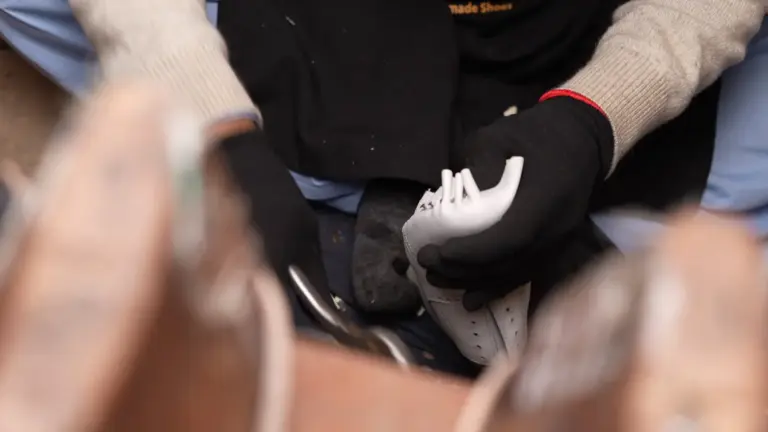
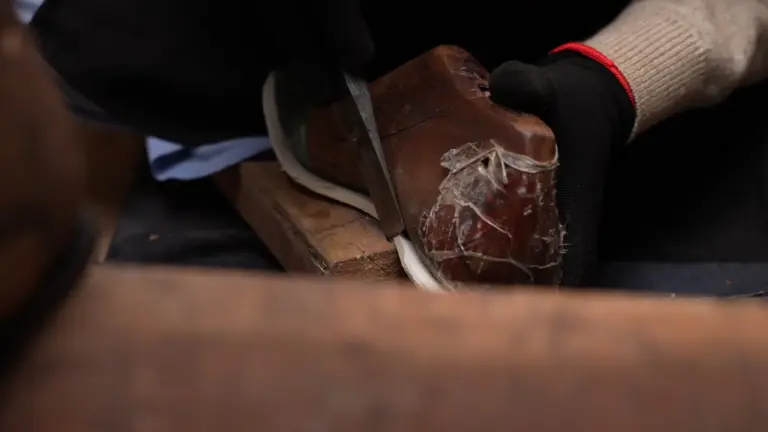
The upper is positioned over the last and tension is applied progressively around the toe, sides, waist and heel.
Pliers, temporary tacks or nails and other workshop tools can be used to control the leather while it is secured to the bottom structure.
The exact sequence varies with pattern, construction and workshop method.
Why tension matters
Too little control can leave wrinkles, asymmetry or excess material. Too much force can distort seams, stretch leather unpredictably or pull the upper off its intended alignment.
Good lasting is therefore not simply “pull harder.” It is about even shaping and knowing where the upper should move.
What role does the last play?
The last is the form being copied.
Hand lasting does not create a custom fit by itself. If a standard last is used, the finished shoe is still based on that standard last geometry.
For that distinction, read Made-to-Order vs Custom vs Bespoke.
Does hand lasting mean bespoke?
No.
A standard made-to-order shoe can be hand lasted on an established last. Bespoke normally involves a much more individualized last/pattern/fitting process.
Method of assembly and level of personalization are separate questions.
What about lasting machines?
Industrial shoemaking uses different machines for toe, side and heel lasting because repeatability and production speed matter.
Machine lasting is not automatically poor workmanship, just as hand lasting is not automatically excellent. Pattern accuracy, last design, material handling and quality control still determine the result.
Why is hand lasting visually useful to show?
It is one of the clearest stages for explaining how a flat upper becomes a shoe.
Handsole’s Our Craft page places lasting within the full sequence from last and pattern to bottom construction and finishing.
The V&A’s Art of Shoe Making is also useful historical context.
What lasting reveals about earlier stages
Lasting often exposes problems that began before the upper reached the last. If pattern pieces were cut inaccurately or closing pulled seams out of alignment, the lasting stage has less room to correct them. Good process therefore depends on each stage handing accurate work to the next.
Leather selection matters too. Different parts of a hide can stretch differently, which is why clicking direction and placement influence how predictably an upper behaves under lasting tension.
Common questions
How long should a shoe stay on the last?
There is no single honest number for every construction and material. Workshops use different setting times. The relevant goal is that the upper holds the intended form before subsequent operations and last removal.
Does hand lasting create left/right custom shoes?
Only if the lasts themselves are individualized. Hand lasting on standard left and right lasts remains standard production, even though the operation is performed by hand.
Deeper considerations
Lasting begins with accurate centering
Before tension is applied, the upper must be positioned correctly on the last so toe, seams, quarters and heel align. A beautifully smooth upper that is twisted off-center is still badly lasted.
Toe lasting vs side and heel lasting
The toe contains complex curves and often reinforcement, so controlling wrinkles and symmetry there requires different handling from drawing the waist or heel. The leather’s ability to stretch also varies by direction and location on the hide.
Temporary fixing and permanent attachment
Tacks or nails may hold the upper while shape is established, but the final construction determines how it is permanently secured to the insole/bottom. Lasting is therefore a shaping stage that interacts with, but is not identical to, welting or sole attachment.
What good hand lasting looks like
Look for centered pattern lines, controlled toe shape, clean heel seating and a surface free from unintended wrinkles. Small differences can exist in handmade work, but the pair should read as balanced and deliberate.
Why leather behavior matters
Soft calf, suede, heavily waxed leather and thicker boot leather do not respond identically to tension. The operator adjusts pressure and sequence rather than applying one fixed force to every upper.
Last removal is also a critical moment
After the bottom structure has progressed far enough, the last must be removed without damaging the upper, lining or opening. A well-lasted shoe should retain the intended form rather than immediately collapsing.
Hand work and repeatability are not opposites
Skilled hand lasting still relies on repeatable references: center lines, pattern positions, toe allowance and visual symmetry. Craft is not random variation; it is controlled judgment within a repeatable process.
Pair consistency is a lasting skill
Each shoe is lasted separately, so the craft includes making two independently handled uppers look like a pair. Toe height, seam position, heel seating and overall tension should correspond from left to right.
This is one reason workshop QC should compare the pair together rather than inspecting each shoe in isolation.
What lasting cannot fix
It cannot correct a badly designed last, inaccurate pattern or miscut component without creating new distortion. Skilled operators can manage leather intelligently, but quality begins upstream.
Why lasting belongs in an authority article
It explains a central truth about footwear: the final shape is not merely stitched from flat pieces; it is formed under controlled three-dimensional tension. That is more useful than generic claims about a shoe being “handcrafted.”
The practical rule
Hand lasting is skilled shape control around a last. It can contribute to a precise build, but the result still depends on the quality of the last, pattern, leather, reinforcement and the rest of the construction.