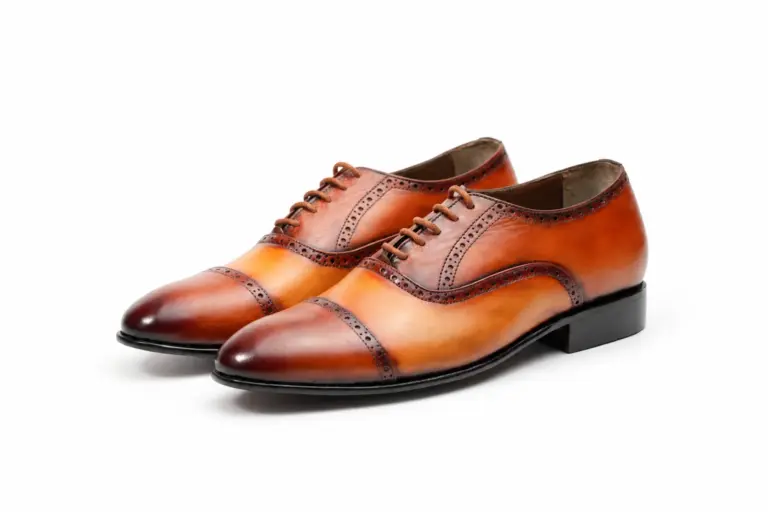
Breaking In Leather Shoes Without Destroying Them — or Your Feet
New leather shoes can soften and flex with wear, but break-in should not be used to excuse the wrong size, width or last. Here is how to separate normal settling from a fit problem.
Break-in means the limited changes that occur as a suitable new shoe flexes and settles through use. It can change how the upper and sole feel, but it should not be relied on to fix insufficient length, strong compression or a shape that does not match your foot. New leather shoes should begin with an appropriate fit.
Start with short indoor trials, your intended socks and careful observation of pressure and movement. Increase wear only if the pair remains comfortable. If pain, rubbing or a persistent fit problem appears, stop and investigate rather than treating discomfort as a necessary admission price for good shoes.
1. Separate normal adaptation from a poor fit
What can change
A new upper can feel more accommodating after repeated normal flexing, and a sole can become easier to bend. The extent depends on the particular materials and construction. An unlined suede loafer, a structured leather Oxford and a substantial boot do not necessarily follow the same adaptation pattern.
That variation makes fixed timelines unreliable. There is no universal number of days or wears that proves a shoe is broken in. Your experience should guide the next trial: whether the pair feels suitable while walking, whether pressure is building and whether your foot remains securely held.
Creases developing in the vamp are part of movement, but they do not prove the shoe is becoming the right size. Nor does an initially firm upper automatically mean poor material. Assess the whole fit rather than treating softness or visible folds as the single measure of success.
What you should not expect
Break-in is not a dependable way to obtain extra length. If your toes meet the front during normal standing or walking, investigate size and shape. Strong forefoot compression and pressure over the instep also deserve attention. Do not assume desirable leather will expand until every mismatch disappears.
Guy’s and St Thomas’ footwear guidance emphasises appropriate fit and indoor trials before committing to outdoor wear. The practical implication is simple: establish suitability first, rather than buying a problem and hoping use will solve it.
Our leather shoe stretching guide separates local adjustment from changing the complete size or shape. Professional stretching may be relevant in some cases, but it is a specific intervention. It is not a universal stage every customer must complete after buying dress shoes.
| Observation | Useful response | Avoid |
|---|---|---|
| General new-shoe firmness without pain | Short, comfortable trials | A fixed deadline for adaptation |
| Toes contacting the end | Reassess size and shape | Expecting extra length from wear |
| Concentrated pressure or rubbing | Stop and identify the cause | Pushing through discomfort |
| Loose heel or unstable hold | Assess volume and fit | Assuming softness will improve security |
| A developing skin problem | Stop the trial and obtain appropriate advice | Treating it as proof of progress |
2. Check the pair before the first extended wear
Use the socks and inserts you actually need
Try the shoes with the socks you expect to wear, not an unusually thin pair selected just to make the fitting easier. Sock thickness affects internal volume and contact. If you intend to alternate between dress socks and concealed socks, assess both combinations rather than assuming they feel identical.
If you use a prescribed insert, follow the guidance you have been given and try the footwear with it in place. Do not add an arbitrary extra insert to make an unsuitable pair tolerable. Our insole versus removable insert guide explains why those components and their effect on space must be considered separately.
Assess both feet. Fit can differ between them, and a pair that feels acceptable on the smaller foot may compress the larger one. Stand, walk and turn normally. A seated fitting or a quick glance at toe length provides too little information about how the shoe behaves in use.
Check each area independently
Notice toe clearance, forefoot room, instep pressure and heel hold. A problem in one area should not be solved automatically by changing length. Increasing size may relieve instep pressure while creating excessive heel movement; decreasing size may stop slipping by compressing the toes. Ask about a different width or shape where appropriate.
Lacing gives some adjustment but does not correct every mismatch. An Oxford and a Derby have different opening arrangements, explained in our lacing comparison. The actual model’s volume remains important. A Derby is not automatically suitable for a high instep, and an Oxford is not automatically unsuitable.
For loafers, assess security particularly carefully because there are no laces. A shoe that moves excessively at the heel should not be assumed to tighten with wear. If you are unsure about movement, read heel slip in dress shoes and discuss the specific pair with the maker.
Inspect the interior
Check for an obvious object, rough edge or displaced component before interpreting a local irritation as break-in. Do not dismantle the shoe, but inspect what is reasonably accessible. If something looks unexpected, photograph it and ask for assessment before trying to alter the interior yourself.
Know the seller’s fitting and return requirements before wearing outdoors or applying care products. A short indoor trial can provide useful evidence while preserving options, subject to the actual policy. Do not make up a return entitlement from general advice; consult the terms for the pair you bought.
3. Introduce wear gradually and respond to evidence
A short first trial
Start in a setting where you can remove the shoes readily. Walk naturally on a suitable clean indoor surface, then take them off and assess how the experience felt. There is no need to aim for a heroic first session. The purpose is to gather information while avoiding an extended commitment to an uncertain fit.
South Tees Hospitals’ footwear advice recommends initially short wear and checking for rubbing, redness or pressure points. Use that principle rather than treating an exact time from another person’s routine as a personal target you must meet.
If the pair remains comfortable, extend use sensibly on later occasions. If discomfort appears, stop and record where it occurred. Note the socks, duration and type of movement. That information makes a discussion with the seller or repairer more useful than saying the shoes are stiff everywhere.
Choose an ordinary, low-pressure occasion
A wedding, long workday or travel day is a poor first test because you may have little opportunity to change shoes. Trial the pair beforehand and retain a familiar alternative where practical. The objective is to arrive knowing the footwear works, not to spend an important event waiting for it to become comfortable.
Do not use a long walk as a shortcut. Extended distance adds wear and gives less opportunity to respond to a developing problem. Short comfortable use provides better information about whether the next session should be longer or whether the fit needs reassessment.
Keep the rest of the routine stable while evaluating the pair. Changing socks, adding inserts and applying several products at once makes it harder to identify what helped or harmed. Change one relevant factor at a time when advised, and assess the result before introducing another intervention.
Rest and storage support the shoe
Let damp shoes dry naturally and follow the maker’s storage guidance. Appropriate shoe trees can support shape, but should not force the upper outward. Trees are not a substitute for professional stretching and should not be oversized in an attempt to create extra room overnight.
A shoe may feel different after resting, but that does not establish that a painful mismatch has been fixed. Repeat the fit assessment. The relevant evidence is comfortable secure walking, not simply that the leather looks more relaxed on the shelf.
4. Avoid aggressive shortcuts and unnecessary treatment
Heat and soaking are not a general fitting method
Do not soak a completed dress shoe or apply direct heat to force it to change shape. The assembly includes more than upper leather: lining, reinforcement, adhesive, insole and outsole may all be affected. A process appropriate to a workshop component is not automatically suitable for a finished pair at home.
Wet socks, hairdryers and other improvised methods can create new problems without resolving the underlying fit. If you think the leather needs a local adjustment, ask the maker or a qualified repairer first. A considered intervention is different from forcing the entire shoe through an uncontrolled wet-and-heat cycle.
Do not freeze water inside the shoe or force objects into it to enlarge it. Those techniques lack the model-specific judgement needed to control where pressure is applied. The safest practical response to an unsuitable new fit is assessment, not increasingly dramatic experiments.
Conditioner is not a sizing tool
Care products should be chosen for the material and finish, not as a promise to make any tight shoe comfortable. Excessive conditioner can alter colour and feel. A product intended for smooth leather may be unsuitable for suede, oily leather or a delicate applied finish. Identify the surface before applying anything.
Our leather care guide explains a restrained routine. A new pair may not need immediate heavy treatment. Follow the maker’s instructions rather than assuming every stiff upper must be saturated before its first wear.
Similarly, pigmented cream and wax do not create extra space. Their functions are different from fit adjustment. Read cream, wax and conditioner if you are deciding which product addresses an actual care need.
Manual bending has limits
Repeatedly folding a new shoe sharply by hand is not the same as normal walking. You can stress an assembly or create unwanted creases. Let the shoe flex naturally during comfortable trials. If a sole feels unexpectedly rigid or the shoe behaves abnormally, obtain advice about the actual model.
Do not crush a structured toe to soften it. A toe puff may be intended to maintain shape, as explained in our toe reinforcement guide. Changing that component is not an ordinary break-in step and can damage the appearance or assembly.
5. Know when to stop and what to ask next
A useful trial record
For an uncertain new pair, keep a brief note after each trial: socks used, walking conditions, location of pressure and whether it improved or worsened. You do not need a detailed diary. A few concrete observations prevent the discussion from becoming an argument about how many days you have endured the shoes.
For example, pressure that appears only with a much thicker sock may call for a different assessment from pressure present immediately with your normal dress sock. Heel movement on one foot and toe compression on the other also deserve separate descriptions. The same overall size change may not solve both concerns.
If a seller recommends an adjustment, clarify what it is intended to change and what it cannot change. Do not accept a general instruction to keep wearing the pair without understanding the reason. Ask whether further trials remain appropriate and how they relate to the seller’s fitting policy.
Keep photographs of visible concerns before applying products or commissioning work. That preserves a useful record of the original pair and makes a later assessment more straightforward.
Contact the seller with a precise description
Explain the location of pressure, the size ordered, socks used and how the shoes behave during walking. Include photographs where a visible issue exists. Ask whether the concern suggests another size, width, shape or a specific adjustment. A precise description is more useful than demanding that the shoe simply be made softer.
Do not continue outdoor wear solely to prove you tried hard enough. That can reduce available options while leaving the problem unresolved. Consult the seller’s policy and obtain guidance early. Some situations may be suitable for professional adjustment; others require a different pair.
Skin problems are not a shoemaking milestone
If the shoe causes a blister or another skin problem, stop using it while addressing the issue appropriately. The NHS blister guidance explains basic care and when to seek help. A blister is not evidence that the leather is successfully conforming or that continued wear is necessary.
If you have reduced sensation, a known foot condition or clinician-provided footwear guidance, follow that advice rather than a general break-in routine. Pain or redness cannot be interpreted reliably through a generic product article. Persistent symptoms deserve appropriate professional assessment.
Use a clear success test
A successful first-wear process leaves you with a shoe that holds the foot suitably and remains comfortable during your normal use. It does not require a particular number of sessions, a specific amount of creasing or a dramatic change in leather softness. Those observations may occur, but they are not the goal.
Buy an appropriate fit, begin with short trials, increase wear only when the evidence supports it and stop when a problem appears. That approach respects both the completed shoe and your feet. Break-in should be a modest part of learning how a suitable pair behaves, not a rescue plan for a purchase that was wrong from the start.