Final Shoe Finishing & Quality Control — What Happens Before a Pair Leaves the Workshop
Construction does not end when the sole is attached. Final finishing cleans the pair, refines edges and color, and gives the workshop one last chance to catch inconsistencies before the shoes leave.
A shoe can be structurally complete and still not be ready to leave the workshop.
Construction leaves traces: dust from sanding, edge color that needs refinement, small adhesive marks, uneven shine, laces that need setting, and left-right differences that are easier to see once the pair is together.
Final finishing and quality control turn a completed construction into a finished pair.
This stage is not a single polish. It is a sequence of cleaning, visual refinement, functional inspection and pair comparison.
Finishing starts with a clean surface
Before adding cream, wax or edge color, the shoe has to be clean enough to evaluate honestly.
Workshop dust can hide surface marks. Adhesive residue can interfere with polish. Fine particles from edge sanding can settle on the upper.
Cleaning reveals what actually needs correction rather than covering everything with product.
The upper is inspected before it is polished
Polish can temporarily disguise minor variation, so inspection should come first.
The finisher checks for scratches, stitching issues, glue marks, uneven color, loose threads, lining contamination and any damage created during construction.
Some issues can be corrected at finishing. Others should go back to the relevant production stage rather than being hidden.
Color balancing is different from repainting
Natural leather and hand finishing create variation.
The goal is usually to make the pair coherent, not to force both shoes into a flat, identical color. On burnished or patinated leather, tonal variation is part of the design.
Finishing may deepen selected areas, soften contrast or bring the left and right shoes closer visually while preserving character.
For the difference between techniques, read Burnishing vs Patina.
Hand-dyed leather needs restraint
Crust and hand-dyed shoes can receive multiple color stages before final polishing.
At finishing, additional pigment should be used carefully. Too much can flatten depth and erase the transitions created earlier.
For material context, see What Is Crust Leather? and Hand-Dyed vs Factory-Finished Leather Shoes.
Cream and wax have different jobs
Cream can nourish and add pigment depending on the product. Wax creates surface shine and can add some protection.
They should not be treated as interchangeable layers applied endlessly.
For the care distinction, read Shoe Cream vs Wax Polish vs Conditioner.
Workshop finishing uses these products for presentation, but long-term care belongs to the wearer after the shoe enters use.
Mirror shine is optional, not a universal quality marker
A highly polished toe can look striking on formal shoes, but not every leather or design benefits from it.
Pebbled leather, pull-up leather, suede and many casual finishes should not be judged by the same gloss standard as smooth calf.
A good finish respects the material rather than forcing every shoe toward the same visual result.
Sole edge finishing is inspected closely
The edge should be even in shape, smooth enough for the intended finish, and consistent left to right.
Color should not bleed onto the upper or outsole. Wax and burnishing should refine the edge rather than create thick residue.
Read Sole Edge Finishing Explained for the dedicated process.
Heel edges and top lifts are checked
The heel is viewed from the back, side and bottom.
The finisher checks alignment, edge consistency, top-lift seating and whether the pair stands evenly. A small asymmetry can become obvious when the shoes are placed side by side.
This is both visual and functional quality control.
Sole bottoms are cleaned and presented
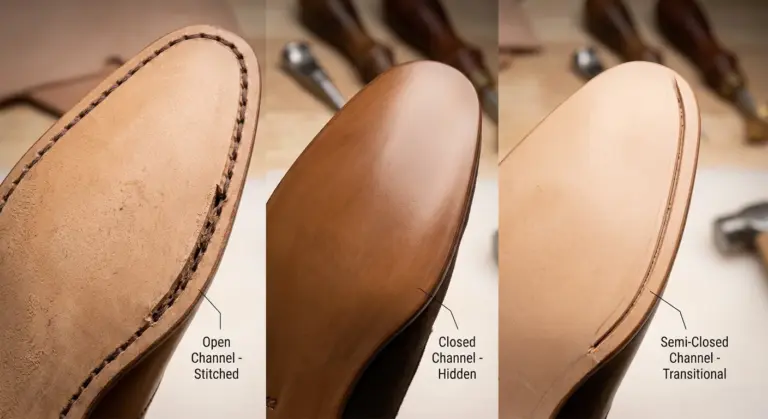
Leather soles may receive stain, branding, channel finishing or other treatments depending on the design.
The final team checks for marks, adhesive contamination and uneven finishing. Rubber soles are inspected for clean trimming and secure attachment.
A beautiful upper does not excuse a careless bottom.
Laces and hardware are part of finishing
Laces should be the correct length, color and condition. Eyelets should be clean. Buckles should operate properly and sit consistently.
On monk straps, the team can check whether adjustment holes align and whether the strap lies flat. On boots, zippers, pull tabs or elastic sections may require inspection depending on design.
These details are small individually and very visible collectively.
The lining and inside are inspected
Dust, thread ends, adhesive or rough seams inside the shoe can affect the wearer directly.
The final check includes the lining, sock area and opening. The workshop looks for anything that could irritate the foot or make the shoe feel unfinished.
This is where hidden construction returns to the quality-control conversation.
Pair matching is a dedicated check
One good shoe plus another good shoe does not automatically equal a good pair.
The team compares:
- color,
- toe shape,
- heel height,
- welt or edge width,
- seam placement,
- brogue alignment,
- hardware position,
- and overall stance.
The left and right shoes should look intentionally related.
Toe shape is viewed from multiple angles
A toe can look correct from above and slightly different from the side.
The pair is compared from top, front and profile. Lasting and bottom work can influence how the final toe reads even if the pattern was identical.
Subtle asymmetry is natural in handmade work, but obvious mismatch should be caught.
Creasing before sale is evaluated carefully
Leather may develop light handling or lasting impressions during production.
The workshop needs to distinguish normal material behavior from damage. Deep uncontrolled creasing, cracks or surface breaks should not be dismissed as “handmade character.”
For wear-stage education, see Leather Shoe Creases vs Cracks.
Stitching receives a final visual scan
Closing quality was checked earlier, but final inspection sees the shoe as a complete object.
Loose threads, skipped stitches, inconsistent seam lines or areas damaged during later stages can still be caught.
If a structural seam is compromised, polishing is not a repair.
The shoe should stand correctly
A finished shoe is placed on a flat surface.
The heel, forefoot and sole should support the shoe as intended. Rocking, obvious tilt or inconsistent heel seating deserves attention.
This check can reveal bottom-making problems that were less obvious while the shoe was held in hand.
Flex is considered without abusing a new shoe
The workshop may gently verify that the shoe behaves as expected, but aggressive bending is not necessary.
A new leather sole and upper will change through wear. Quality control should confirm construction, not artificially “break in” the product before the customer receives it.
For break-in expectations, read How Long Does It Take to Break In Leather Shoes?.
Size and order configuration are checked
For made-to-order work, the physical pair has to match the order.
Size, width, color, sole choice and other confirmed configuration details should be checked before packing.
This administrative check is just as important as polishing. A perfectly finished shoe in the wrong size is still the wrong order.
Custom requirements need explicit verification
Custom Made requests can include changes beyond standard product options.
Those requirements should be reviewed against the actual finished pair rather than assumed to have carried through production automatically.
Handsole distinguishes standard made-to-order configuration from Custom Made, where changes beyond normal options require review.
Photography can expose inconsistencies
Studio or product photography is not only marketing.
Strong light can reveal edge variation, asymmetrical burnishing, uneven toe shine or marks that were less visible under workshop lighting.
Photography should not replace physical inspection, but it can become another quality signal.
Packing should protect the finish
A final polish can be damaged by careless packing.
Shoes should be protected from rubbing against each other and from hard accessories. Stuffing or support should preserve shape without overfilling the toe.
For travel and storage principles, see How to Pack Dress Shoes for Travel and How to Store Leather Shoes Long-Term.
Quality control is not “perfect handmade symmetry”
Handmade work can contain small signs of process.
The purpose of QC is not to make leather look injection-molded. It is to ensure that natural variation and handwork do not cross into structural problems, distracting mismatch or avoidable finishing defects.
That distinction matters. “Handmade” should not be used as an excuse for poor execution.
Read Handmade Leather Shoes — What “Handmade” Actually Means for the broader principle.
A useful final-inspection checklist
A workshop can think through the final pair in five groups.
Upper: leather surface, seams, color, hardware and pair balance.
Inside: lining, rough edges, loose threads and cleanliness.
Bottom: sole alignment, edge finish, heel seating and surface condition.
Fit configuration: size, width, last/design and order options.
Presentation: laces, polishing, packing and labeling.
The checklist does not replace judgment; it helps make judgment repeatable.
What should never be hidden by finishing?
Structural damage, wrong sizing, failed stitching, severe leather defects and construction errors should not be disguised with polish or edge ink.
Finishing is refinement, not concealment.
A good workshop knows when to correct, remake or reject rather than push a problem forward.
Common questions
Is final finishing just polishing?
No. It includes cleaning, edge and color refinement, hardware and lining checks, pair matching, bottom inspection and order verification.
Does a high shine mean better leather?
No. Shine depends on leather finish and polishing. Many excellent leathers are intentionally matte or textured.
Should handmade shoes be perfectly identical?
A pair should be visually coherent and structurally consistent, but natural leather and hand processes can create small variations.
When does quality control happen?
Ideally throughout production, with a final comprehensive inspection before packing.
The practical takeaway
Finishing is the last opportunity to see the shoe as the customer will see it.
Every earlier stage—pattern, clicking, closing, lasting and bottom making—comes together in the final pair. Quality control asks whether those decisions still align: does the pair match, does it stand correctly, is the inside clean, is the finish appropriate, and does the order configuration match what was promised?
A careful workshop does not use the last polish to hide construction. It uses finishing to reveal that the construction was worth finishing.
Quality control should happen before the final table
The final inspection is important, but it should not be the first time anyone asks whether the work is correct.
Pattern, clicking, closing, lasting and bottom making each have their own natural checkpoints. Catching an error at the stage where it was created reduces waste and prevents later teams from building more work on top of a problem.
Final QC is therefore the last gate in a sequence of gates, not a substitute for process discipline.
Different materials need different finishing rules
Smooth calf can accept cream and wax. Suede and nubuck require brushing and material-appropriate care. Patent leather has a coated surface that should not be treated as ordinary calf. Pull-up leather can change tone when oils move through the material.
A finishing team that uses one universal product on every shoe can damage the very surface it is supposed to improve.
Material identification has to come before finishing technique.
Acceptable variation vs a defect
Natural leather can show grain variation, tonal depth and small signs of hand processing.
A defect is different: cracked leather, failed stitching, loose sole attachment, a visibly tilted heel or severe pair mismatch is not “character.”
Quality control needs clear standards so the workshop does not reject every natural variation—or excuse every production problem.
Documentation improves repeatability
For repeated styles, QC findings can feed back into the process.
If the same seam repeatedly drifts, the pattern or closing guide may need adjustment. If one edge finish chips during handling, the finishing sequence may need review. If a particular material reacts poorly to adhesive, the preparation method may need to change.
Recording recurring issues turns inspection into process improvement rather than repeated firefighting.
When a pair should be corrected, remade or rejected
Not every issue deserves the same response.
A loose thread or small polish inconsistency may be corrected safely. A major color mismatch may require refinishing or replacing a component. A structural error, wrong size or damaged upper can justify a remake.
The key principle is that finishing should never be used to disguise a problem that remains structurally or functionally wrong.
Packaging is part of the customer experience
The pair can pass every workshop check and still arrive poorly if packaging allows the shoes to rub, collapse or shift.
Support should preserve shape without forcing the toe. Accessories should be separated from polished surfaces. Moisture should not be trapped inside immediately after finishing.
The last workshop operation is therefore not “apply wax.” It is getting the finished pair safely from the bench to the customer in the condition that QC approved.
Where to go next
Finishing and quality control close the workshop sequence that begins with Pattern Making and continues through upper and bottom construction. To understand the lower assembly before finishing, see Bottom Making. For what a customer can inspect on arrival, continue to What to Check When New Leather Shoes Arrive, or return to the construction hub.
Feedback closes the loop
Wear feedback can reveal issues that a static inspection cannot.
Repeated reports of heel movement, premature lining wear, edge failure or another consistent problem should be investigated against fit, materials and process.
Good quality systems learn from finished products instead of assuming that inspection ends the moment the box leaves the workshop.