Shoe Cream vs Wax Polish vs Conditioner — What Does Each One Do?
Conditioner is not polish, cream is not hard wax, and more product is not automatically better. Here is what each layer is actually for.
Good shoe care is about using the right product for the job—not building the thickest possible layer.
Conditioner, shoe cream and wax polish are often treated as interchangeable.
They are not.
All three can appear in a leather-shoe care routine, but they solve different problems. Using the wrong one—or using too much of all three—can leave leather greasy, overcoated or difficult to maintain.
The simplest system is to ask what the shoe actually needs before opening a jar.
What does leather conditioner do?
Conditioner is primarily about the leather itself.
Its role is to restore lubricating components and help prevent the leather from becoming excessively dry or stiff.
Conditioner is not automatically required every time you wear or clean the shoes.
Over-application can darken absorbent leather, soften it more than intended or leave residue. Apply lightly, test unfamiliar products discreetly and let the leather tell you when it actually looks or feels dry.
The Canadian Conservation Institute takes an intentionally restrained approach to dressings and lubricants in its leather-care guidance, which is a useful reminder that “more conditioning” is not a universal preservation strategy.
What does shoe cream do?
Shoe cream normally combines conditioning ingredients, pigment and a moderate level of waxes or other finishing components.
It is useful when a smooth leather shoe needs:
- color refreshment
- light conditioning
- a soft sheen rather than a hard mirror finish
Cream is especially useful on flexing areas because it does not build the same brittle surface film that repeated heavy hard-wax layers can create.
Crockett & Jones notes in its grain-leather care guidance that shoe cream contains more color pigment than wax polish and can be used to restore depth of color before wax is added for protection.
What does hard wax polish do?
Hard wax polish is primarily a surface-finishing product.
It can add gloss, deepen color and create a more water-resistant polished surface.
Because the wax layer is harder, it is best built gradually and is especially suitable for areas that flex less, such as the toe and parts of the heel.
Heavy wax on the main flex zone can crack as the leather bends.
A high shine is therefore not simply “conditioner plus more rubbing.” It is a different surface treatment.
What order should you use them in?
For smooth leather that genuinely needs all three:
- remove dry dirt and clean only as necessary
- condition lightly if the leather is dry
- use cream if color or surface nourishment needs refreshing
- add small amounts of wax where you want extra shine or protection
You do not need every step every time.
If the shoes are clean, the leather feels healthy and the color looks good, brushing may be the only thing required after ordinary wear.
What about suede and nubuck?
Do not use this smooth-leather routine on a napped surface.
Suede and nubuck need brushing, cleaners and protectors designed for that texture. Cream and hard wax can flatten the nap.
Use How to Clean Suede Shoes instead.
How often should you condition or polish?
There is no responsible fixed calendar that fits every shoe.
Frequency changes with:
- how often the pair is worn
- climate and humidity
- exposure to rain or dust
- the leather’s tannage and finish
- how absorbent the leather is
A pair worn once a week in an office does not need the same care rhythm as a pair worn outdoors every day.
Our broader cleaning and conditioning guide uses the same need-based approach.
Common product mistakes
Conditioning every time you polish
This can create unnecessary buildup or over-softening.
Trying to replace missing color with clear wax
If the leather has visibly faded, pigmented cream is usually the more logical first step.
Building mirror wax over the vamp flex point
The hard surface layer will be asked to bend repeatedly and can crack.
Using smooth-leather products on suede
Different surface, different care system.
Deeper considerations
Why one product cannot do every job equally well
Conditioning, color restoration and high shine are different goals. Products sometimes combine several functions, but a formula optimized for deep conditioning will not behave exactly like a hard finishing wax, and a heavily pigmented cream is not the same thing as a neutral conditioner.
Separating the jobs helps you use less product and preserve the character of the leather.
A practical decision sequence
If the leather is dirty, clean it first. If it is dry, condition it. If color looks uneven or scuffed, use cream in an appropriate shade. If you want more surface gloss or added water resistance at low-flex areas, finish with wax.
Do not automatically perform every step every time. A healthy pair may need only brushing.
Where wax belongs—and where it does not
Hard wax works best on relatively rigid areas such as toe and heel. Thick layers across the vamp can fracture visually as the shoe flexes. That is one reason mirror shine is usually concentrated at the toe rather than spread over the entire upper.
Color-matching hand-finished shoes
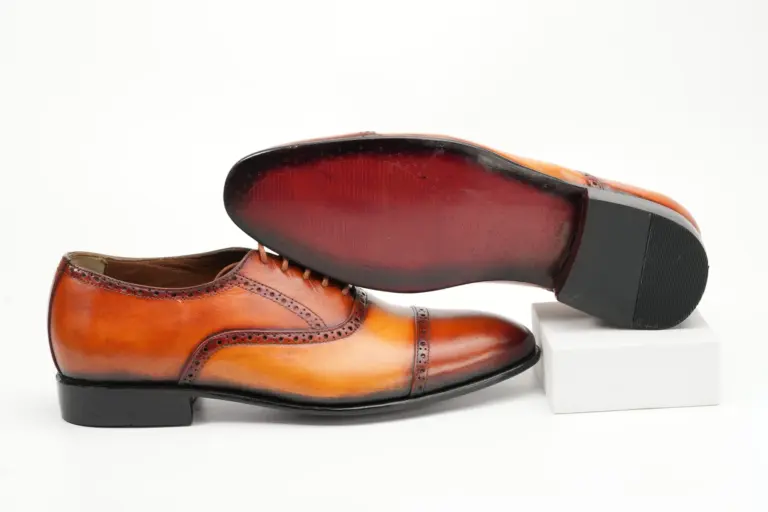
On burnished or patinated leather, opaque cream can flatten tonal variation. Start with a neutral or carefully selected shade, work lightly and preserve the darker/lighter areas intentionally built into the finish.
The practical rule
Conditioner treats dryness. Cream refreshes leather and color. Wax builds surface shine and protection.
Brush first, use the minimum product needed and let each layer dry or settle before deciding whether the shoe needs anything more.