Penny Loafers Buying Guide — Fit, Aprons, Soles & When to Wear Them
A practical penny-loafer buying guide covering fit, keepers, aprons, leather, lining, soles, construction and what to confirm before ordering.
To buy penny loafers well, choose for fit and everyday use before deciding on color. Check heel hold, instep volume and forefoot room, then compare the keeper, apron, leather, lining, sole and construction. The recognizable strap identifies the style; it does not tell you whether the particular shoe will work for your foot.
A dark leather penny can serve office trousers and relaxed tailoring, while suede or a more substantial silhouette may suit chinos and denim. But two shoes called penny loafers can feel and behave differently. This guide shows you how to read the product information, examine the photographs and conduct a useful try-on before committing to a pair.
1. Define the job and read the penny loafer’s design
Choose for your actual week
Start by naming the clothes you will wear most often with the shoes. Grey wool trousers and a navy jacket suggest a different direction from heavy denim and an overshirt. If the pair must cover both, look for a moderate silhouette and a color you already use rather than expecting an extreme dress or casual design to do everything.
Also name the activity. A mostly indoor office day differs from a commute involving wet pavements and extended walking. A wedding requires a dress-code check and enough time to assess the fit. Your intended use helps you choose a sole and upper; the word versatile should not override these practical differences.
Pick two or three specific outfits as a test. If the shoes only work with an imagined wardrobe, account for the cost of building that wardrobe too. A shoe that fits comfortably and supports what you own can be a better purchase than a more striking pair that creates several new clothing decisions.
Understand the keeper, vamp and apron
The penny keeper is the leather strap across the vamp with a characteristic opening. A broad keeper creates a stronger horizontal feature; a narrow one can appear more restrained. Contrast stitching or contrasting leather changes its presence again. None of these choices alone proves superior craftsmanship.
The vamp is the upper area over the front of the foot. Compare how far it extends toward the ankle and how high the opening appears. A long-looking vamp may cover more of the foot, but visual coverage does not establish instep volume or heel security. Those depend on the pattern and last as well as the material and lining.
The apron is the feature around the forepart. It may be expressed as a raised seam, a butted join or another pattern treatment. Penny describes the keeper; apron describes a different feature. Look at how they work together rather than treating an apron-toe loafer as a separate alternative to a penny loafer.
Crockett & Jones distinguishes several apron treatments in its guide to loafers. Use that distinction to ask a precise question if the method matters to you. A visible seam cannot, by itself, verify whether it was hand sewn or identify the sole’s construction.
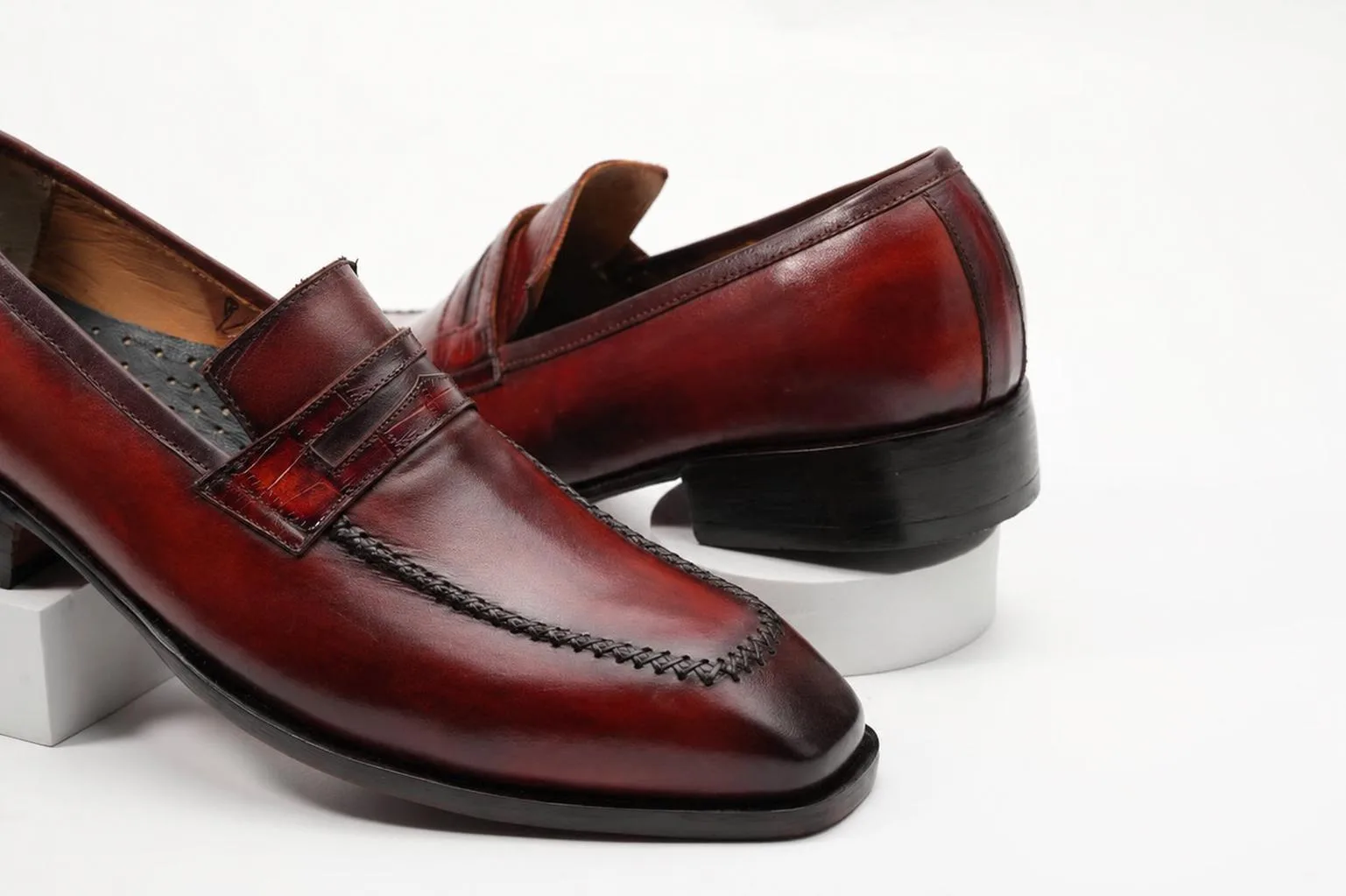
Read the shape from several angles
A top view helps you compare the toe and forepart; a side view reveals sole thickness, heel and vamp profile. An angled photograph can make a toe look longer or narrower than it is. Compare similar angles and avoid assuming that the most elegant photograph represents the most suitable fit.
Rounded, almond, square and chisel descriptions are useful visual starting points, but the toe shape does not describe the entire last. A shoe can have a slim-looking toe and generous room farther back, or a broad-looking forepart with an instep that does not suit you. Our shoe last guide explains why shape and fit need to be assessed together.
2. Assess fit without using tightness as a shortcut
Start with measurements and the model’s guidance
Use your current measurements, intended socks and any well-fitting shoe references when speaking with the seller. State the size system clearly. A US size is not interchangeable with a UK number, and a sneaker size is not a reliable conversion for every dress shoe. Width labels also need to be interpreted within the maker’s system.
Brannock’s fitting instructions treat foot length, arch length and width as distinct measurements. The buying implication is modest but useful: the length number alone is incomplete. Follow Handsole’s foot measurement instructions when providing dimensions, and explain any recurring pressure or looseness in your present shoes.
Do not import another brand’s universal sizing recommendation into a Handsole order. “Go down half a size” might reflect one model or one wearer’s experience. It is not a rule for penny loafers as a category. Ask about the particular last and size-width combination when the guidance conflicts with your normal experience.
Check the forefoot, instep and heel together
With the intended socks on, stand naturally. Your forefoot should sit without being squeezed across the ball, and the instep should feel supported without painful pressure. The toes should not be jammed against the end. Empty decorative toe space is not automatically excess length, especially in an elongated shape.
Next, walk indoors under the seller’s try-on conditions. Assess whether the heel stays controlled and whether the foot slides forward. A shoe can feel snug while standing yet become insecure in motion. Conversely, a stiff new sole may contribute to some movement without the whole shoe being excessively large. The degree and cause need assessment rather than a fixed rule.
If reducing heel movement makes the forefoot painful, the smaller size is not a good solution. You may need a different heel-to-forefoot relationship, width or pattern. Consult the loafer fit guide and, where relevant, fitting a narrow heel with a wider forefoot.
Do not make break-in responsible for the wrong size
Leather and the rest of the shoe can change with wear, but that does not make every uncomfortable fit acceptable. Distinguish initial stiffness from persistent pressure, sliding or restricted toes. A purchase should not depend on an unverified promise that a painful upper will expand exactly where you need it.
G.H.BASS’s loafer fit guidance is useful background for understanding its shoes. Use any maker’s guidance in the context of its models rather than as a guarantee about another range. The leather stretching guide explains the limits of treating future wear as a sizing strategy.
If you expect to use an insert or orthotic, ask before ordering whether the specific shoe accommodates it and whether its insole is removable. Extra material under the foot changes available volume and can lift the heel relative to the opening. Do not assume a slip-on has the depth or adjustability of a lace-up.
3. Compare leather and lining for appearance and use
Choose the surface you want to live with
Smooth leather offers a relatively clean visual surface and can be maintained to different levels of shine, depending on its finish and suitable products. Dark smooth pennies are an easy editorial starting point for tailored clothing. However, the words smooth leather do not specify the hide, tannage or finishing system, so read the material description.
Suede creates a softer appearance that can work with cotton trousers, denim and knitwear. Nubuck also has a nap, but it is not simply another name for suede. If the difference affects your choice, read suede versus nubuck. Both need care chosen for the particular material rather than a routine intended for polished smooth leather.
Grain leather adds visible texture; embossed patterns can add a stronger graphic effect. A croc-embossed description refers to a pattern and does not, without further specification, mean crocodile leather. Patina may create deliberate shade variation. Choose these features because you like their appearance and care requirements, not because texture or color complexity automatically signals better leather.
Think about color in relation to your trousers
Dark brown is a useful bridge across navy, grey, stone and olive clothing. Black supports a sharper dark wardrobe and can suit an office that accepts the style. Burgundy introduces another color while remaining relatively easy to compare with navy and grey. Tan and cognac make the shoe more noticeable, especially under dark trousers.
These are outfit starting points. The shade, shine and sole can change the result. A red-burgundy patina penny is not visually equivalent to a subdued oxblood shoe just because both sit in a broad red-brown family. If possible, assess the actual pair or a representative photograph in ordinary light.
If you are undecided, place product images beside photographs of your three intended outfits. Choose the color that needs the fewest additional adjustments. If both work equally well, preference can settle the decision. There is no need to buy dark brown first when black already fits the clothes you wear and the impression you want.
Lined and unlined require model-specific comparison
Lining changes the interior and can contribute to structure and feel. An unlined upper may feel more flexible in some designs, but that does not establish that it will fit a narrow heel better or suit every warm-weather use. Upper thickness, pattern and the rest of the build still matter.
Check the lining material and its extent. A product described as leather lined may still need clarification about the insole or other interior components if those matter to you. “Leather insole” can also be used loosely in retail copy. Ask whether the description refers to the structural insole, an interior covering or a removable insert.
For a closer comparison, read lined versus unlined shoes and leather insoles versus removable inserts. Keep the question concrete: which configuration gives this particular shoe the feel, structure and usable volume you need?
4. Read sole and construction information before comparing price
Inspect the sole profile as well as its material
A thin-looking sole creates a different silhouette from a thick welt and lugged outsole. Rubber can be discreet or substantial; leather soles also vary in thickness and finishing. Do not choose material first and assume the visual result follows automatically. Look at the side and outsole photographs alongside the written specification.
Crockett & Jones’s sole guide illustrates leather and several distinct rubber options within one maker’s collection. It is evidence that “rubber sole” is a broad category, not one appearance or behavior. Its descriptions of individual soles should not be transferred to an unspecified sole on another brand’s shoe.
For a mostly indoor setting, a refined profile may be the priority. For a wet commute, ask about the actual outsole and consider the conditions you encounter. Neither rubber nor leather alone establishes tested traction, waterproofing or suitability for an occupational requirement. The leather and rubber comparison keeps those distinctions separate.
Find out how the outsole is attached
The penny keeper does not identify the construction. Look for a specific description of the method used to attach the sole, and ask if it is missing. Visible stitching can be misleading when viewed only in a photograph; it is not sufficient evidence to assign a method confidently.
If repairability matters, ask about the particular build and available repair route. Do not assume every welted shoe can accept any replacement sole, or that every resoleable shoe will be economical to repair. The state of the upper, the repairer’s equipment and the available components can affect the decision.
Our Blake, Goodyear welt and hand welt comparison explains the main differences. Use it to interpret specifications, not to declare one construction the best choice for every wearer. A method that suits a slim dress loafer may differ from the approach you would choose for a heavier everyday shoe.
Compare like with like when assessing value
Two penny loafers at similar prices may differ in upper material, lining, outsole, manufacturing method and service. Conversely, a higher price can include brand positioning and distribution costs rather than a feature you personally need. Build a short comparison around stated specifications instead of relying on photographs and adjectives.
| Area | What to establish | Why it matters |
|---|---|---|
| Fit | Model guidance, size system and width options | A suitable shape matters more than decoration |
| Upper and interior | Leather, finish, lining and insole description | Appearance, care and interior volume differ |
| Sole | Material, profile and any specific performance claim | Looks and intended use need separate checks |
| Construction | Attachment method and repair route | The penny label does not describe the build |
| Order terms | Availability, timing, fit support and return conditions | The full purchase extends beyond the shoe price |
Do not let an appealing keeper or apron stand in for an answer that is missing from the listing. If a specification is important to the decision, ask before paying. That is particularly useful when ordering a pair made after purchase, where timing and the scope of changes may differ from an in-stock order.
Where to go next: Compare the penny format with Horsebit vs Tassel vs Penny Loafers, then use How Should Loafers Fit? before choosing size or width. Return to The Complete Guide to Men’s Loafers for the full style map.
5. Order, try on and decide whether to keep the pair
Resolve timing and order terms in advance
Confirm whether the pair is in stock, made to order or part of a separate custom service. Ask about the current production estimate, delivery destination and deadline if you have one. Do not interpret a production estimate as a guaranteed arrival date; shipping and any fitting discussion also take time.
Read the current return and alteration conditions for your specific order before trying to customize anything. A different color, size or production route may come with different terms. If you need split sizes, a particular width or another accommodation, ask what is actually available rather than assuming that “handmade” includes every request.
The made-to-order, custom and bespoke guide explains the terminology. When reviewing Handsole products, rely on the individual specification and confirmed service scope. Do not infer a personal last or guaranteed fit from the fact that a pair is produced after ordering.
Make the indoor try-on deliberate
Try both shoes with the socks you plan to use and follow the seller’s instructions about surfaces and walking. Use a shoehorn rather than forcing the heel down under your foot. Look for a balanced feel across the forefoot and instep, then assess the heel during normal movement.
Record where an issue occurs rather than reporting only “too big” or “too small.” For example, a loose heel with a comfortable forefoot suggests a different conversation from excess room everywhere. Pressure across the instep with adequate width should not automatically trigger a wider-size recommendation. Clear observations help the seller assess the problem.
Also test the shoes beneath your intended trousers. Stand and sit, check the hem, and compare with the pair you normally wear. A change in silhouette can take some adjustment, but the fit should not depend on altering your gait. If the problem is appearance, decide whether a trouser alteration is worthwhile; if it is discomfort or insecurity, address the shoe.
Choose a first penny for use, not an imagined universal role
A Reddit question about choosing a first black penny loafer asks which details make a design casual or formal. That is a useful customer question, not technical evidence. The answer is to consider shape, apron, finish and sole together, then match that combination to your actual settings.
If the pair fits and works with your weekly clothes, you do not need it to cover formal evening dress, heavy rain and every summer outfit too. You can use another shoe for situations with different requirements. A well-defined role helps the purchase earn regular wear and makes future additions easier to judge.
Compare current Handsole loafers using the questions above. If you are still deciding whether the penny keeper is the detail you prefer, read penny versus tassel versus horsebit. Once the pair is chosen, the loafer outfit guide shows how to build complete combinations around it.