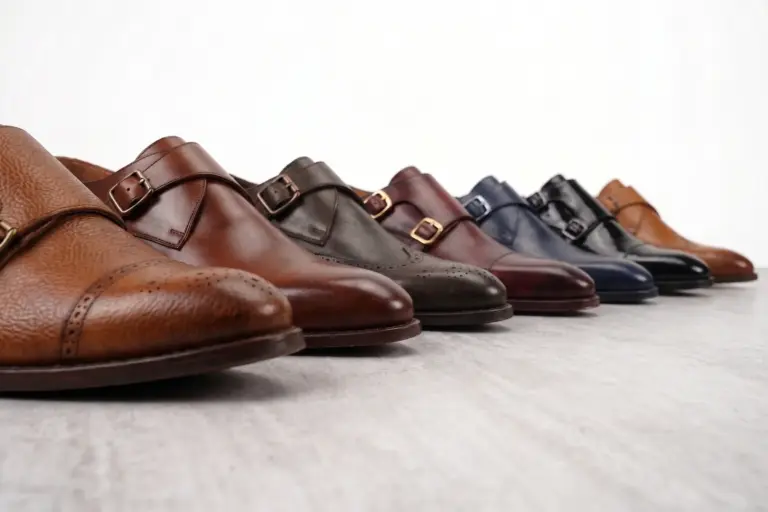
Monk Strap vs Loafer — Buckle Closure or Slip-On?
Both avoid conventional laces, but a monk strap still uses an adjustable closure while a loafer relies on the shape of the upper and last.
Monk straps make the closure visible. Loafers make the absence of closure part of the design.
Monk straps and loafers are both alternatives to traditional lace-up dress shoes, but they are not the same kind of slip-on.
A monk strap secures the foot with a strap and buckle. A loafer has no adjustable closure.
Monk strap: closure becomes a design feature
The buckle sits visibly on the side of the shoe, making the fastening part of the style.
A single monk usually looks cleaner. A double monk adds more visual presence.
See Monk Strap Shoes Explained.
Loafer: no closure hardware
A loafer depends on the vamp, topline, instep and heel shape to hold the foot.
That creates a simpler upper and makes the shoe easy to slip on and off.
Which is more formal?
A sleek dark monk strap can work with suits and formal business clothing, though it is less conventional than an Oxford.
A dark polished loafer can also work with tailoring, but loafers generally move more naturally into relaxed settings.
Which gives more fit adjustment?
Monk straps provide some adjustment through the buckle position.
That does not mean they fit every instep; the last still defines the basic volume.
Loafers offer less adjustment and therefore need more accurate initial fit.
Which is easier with casual clothing?
Loafers are especially easy with chinos, denim and warm-weather outfits.
Monk straps can also work with smart casual clothing, but the buckle makes a stronger statement.
Which should you choose?
Choose monk straps if you like visible hardware and want a non-lace closure with some adjustability.
Choose loafers if you want maximum slip-on simplicity and a broader relaxed range.
Single monk, double monk or loafer?
A single monk is the quietest bridge between lace-up formality and loafer simplicity. A double monk creates more hardware and visual rhythm. A loafer removes the fastening entirely.
If your wardrobe is conservative, single monk is easier to integrate. If you prefer expressive footwear, double monk or decorative loafers create more personality.
Common questions
Can monk straps be worn with suits?
Yes, especially in dark smooth leather. They are less conventional than Oxfords but still firmly within dress footwear.
Do buckles stretch less than loafers?
The buckle allows minor tension adjustment, but the upper and last still determine the basic fit. Do not treat the strap as a substitute for the correct size.
Deeper considerations
Monk straps sit between lace-ups and loafers
They remove conventional lacing but retain a mechanical closure. That gives them some of the adjustability of a lace-up while keeping the upper visually cleaner.
Single vs double monk changes the visual weight
A single buckle is easier with conservative tailoring because it creates one focal point. Double monk adds hardware and movement, making the shoe more expressive and naturally suited to smart casual or fashion-forward business wear.
Fit at the instep
The buckle can fine-tune tension, but the strap has limited travel. If the last is fundamentally too low over the instep, moving one hole is not enough. If it is too high-volume, the strap can close fully while the foot still moves.
Loafer simplicity has a trade-off
The absence of hardware makes loafers visually versatile, but all hold must come from shape. That is why a perfectly fitted loafer can feel effortless while a poorly matched one is difficult to correct.
Which one travels better?
Loafers win for speed. Monk straps take slightly longer but can be adjusted and often hold more securely for walking.
Wardrobe role
Choose monk straps if you already own Oxfords/Derbies and want a distinctive dress alternative. Choose loafers if you need warm-weather, smart-casual and slip-on range.
Common questions
Do monk straps need to match the belt buckle?
No. Metal finishes should not clash aggressively, but exact hardware matching is unnecessary.
Can double monks be worn with a suit?
Yes in many business and wedding contexts. They are more expressive than single monks or Oxfords, so the rest of the outfit should remain controlled.
Are loafers more comfortable?
Not inherently. Comfort follows fit, last, lining and sole. Slip-on convenience is not the same as better fit.
How the closure changes the visual rhythm
Monk straps put asymmetry on the side of the shoe, while loafers keep the upper centered and uninterrupted. That makes monks feel more designed and loafers feel more effortless. If the rest of your wardrobe is minimal, a monk can become the focal point; if you already wear patterned tailoring or strong accessories, the quieter loafer may integrate more easily.
The practical rule
Monk strap = buckle-adjusted dress shoe. Loafer = true laceless slip-on.
Let your wardrobe and foot shape decide which closure earns more wear.