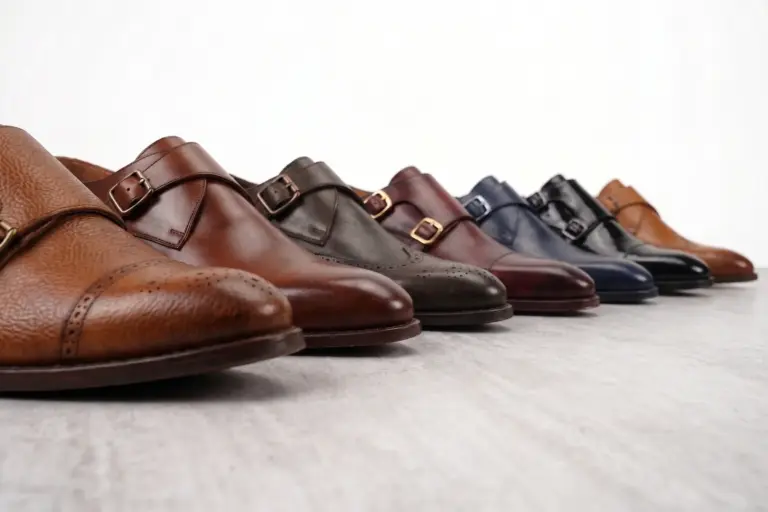
Wholecut vs Cap-Toe Oxford vs Brogue — Which Dress Shoe Is Right for You?
Wholecut, cap-toe and brogued Oxfords can all use the same closed-lacing foundation, but their upper patterns create very different levels of formality and visual detail. Learn which style fits your wardrobe and what the name does—and does not—tell you.
Wholecut, cap-toe and brogue are upper patterns layered onto the Oxford foundation.
Wholecut, cap-toe and brogued shoes can look like three completely different categories.
They are not.
All three can be Oxfords.
The Oxford part describes the closed-lacing architecture.
Wholecut, cap-toe and brogue describe different ways of designing the upper around that architecture.
Crockett & Jones’ Oxford guide lists wholecuts, toe caps, full brogues, semi-brogues and other patterns as variations within the Oxford family.
That distinction matters because it stops you comparing the wrong things.
You are not deciding between three construction methods.
You are deciding how much seaming, panel structure and decoration you want on a dress shoe.
Start with the Oxford foundation
An Oxford is defined by its closed lacing.
The quarters are stitched beneath the vamp rather than sitting freely over it as they do on a Derby.
That creates the clean facing associated with formal dress shoes.
Once that foundation is established, the upper can be patterned in several ways.
A wholecut minimizes visible seams.
A cap-toe adds a clear horizontal panel line across the front.
A brogue adds decorative perforation and often more complex panel shapes.
So the first useful rule is:
Oxford = closure.
Wholecut / cap-toe / brogue = upper design.
If you are comparing open vs closed lacing rather than these upper patterns, use the Handsole guide to Oxford and Derby architecture rather than treating brogue as a third closure type.
What is a wholecut shoe?
A wholecut upper is made from one primary piece of leather shaped around the foot, with minimal seaming.
In a conventional wholecut, there is usually a seam at the rear where that single piece is joined.
The result is an unusually uninterrupted upper.
There is no separate toe cap.
There are no wingtip panels.
There are fewer visual lines competing with the leather and last.
That simplicity is the point.
Wholecut does not always mean seamless
This distinction matters.
A standard wholecut can still have a rear seam.
A seamless wholecut goes much further and eliminates even that seam.
Shoegazing’s detailed history of the seamless wholecut explains why producing a truly seamless upper is an unusually demanding specialist exercise.
So do not assume every wholecut is seamless.
If a product is genuinely seamless, say so specifically.
If it is a conventional wholecut with a back seam, wholecut is already the correct description.
Why wholecuts look so clean
With fewer panel lines, your eye is drawn to three things:
the last
the leather
the finishing
That can make a wholecut look exceptionally refined.
But it can also make weaknesses harder to hide.
On a heavily paneled shoe, seams and broguing create visual activity.
On a wholecut, an uneven lasting line, poor leather selection or awkward shape has nowhere to disappear.
This is one reason wholecuts are often associated with fine dress footwear.
It is not because “one piece of leather” automatically guarantees quality.
It is because a minimal pattern puts more visual responsibility on the leather, shape and execution.
Does wholecut mean better leather?
Not automatically.
A wholecut requires a sufficiently large and suitable section of leather for the upper pattern.
That can make leather selection particularly important because there are fewer panel boundaries where different pieces can be placed independently.
But the term wholecut does not tell you:
- the animal source
- grain condition
- tannage
- finish
- thickness
- quality of clicking
- whether the leather suits the shoe
For those questions, use the Leather Knowledge Hub and then read the actual product specification.
One-piece patterning is a design choice.
It is not a leather grade.
What is a cap-toe Oxford?
A cap-toe Oxford adds a visible horizontal seam across the front of the shoe.
The toe appears to be divided into a separate cap and the vamp behind it.
This is one of the most familiar business-shoe patterns.
The extra line gives the shoe structure without introducing the amount of decoration found on a full brogue.
That balance is why dark cap-toe Oxfords have become such a common business and formal choice.
Is the toe cap always structural reinforcement?
Do not assume so.
Different patterns can use overlays, seams or visual constructions differently.
The safest description is that the cap toe creates a distinct toe panel or cap line.
If a specific product uses an actual reinforcing layer beneath or within that construction, the product page can say so.
The style name by itself should not be used to promise extra durability.
Why cap-toes are so versatile
A plain cap-toe gives the eye one clear piece of structure.
It is more visually defined than a wholecut but quieter than a brogue.
That makes it easy to combine with:
- business suits
- formal trousers
- weddings
- office clothing
- smarter separates
Color, leather, last and sole still determine how formal the final shoe feels.
A black calf cap-toe on a refined last can be very formal.
A tan cap-toe on a heavier sole becomes considerably more relaxed.
The pattern provides the framework.
The rest of the specification sets the tone.
What is a brogue Oxford?
A brogue Oxford combines closed lacing with decorative perforation and panel detailing.
The broguing may be restrained or extensive.
A quarter-brogue can keep a straight cap and add only limited perforation.
A semi-brogue adds more decoration and commonly a toe medallion.
A full brogue introduces the wingtip pattern and much more visible detail.
So “brogue Oxford” covers a range.
If you need the full taxonomy, read Brogue Shoes Explained.
That article should remain the authority for quarter, semi, full and longwing patterns.
This article has a different job:
help you choose between minimal, structured and decorative dress-shoe uppers.
Wholecut: the visible upper is cut from one principal piece of leather, so the design is defined by minimal seams and a clean surface.
Cap-toe Oxford: a separate toe cap adds structure and a clear horizontal line while the Oxford closure keeps the lacing visually formal.
Brogue: perforation, pinking and pattern work add decoration. A brogue can still use an Oxford or Derby closure, so “brogue” describes the detailing rather than the lacing system.
Wholecut vs cap-toe vs brogue: which is most formal?
There is no mathematical ranking because color, leather, last and sole can move every style.
But when all other variables are kept similarly restrained, a useful direction is:
Wholecut / plain Oxford → minimal
Cap-toe Oxford → classic formal structure
Quarter or semi-brogue Oxford → formal with decoration
Full brogue / wingtip → more expressive and generally less formal
Wholecuts are often treated as highly formal because their upper is exceptionally clean.
Cap-toes, however, are arguably the most conventional business-formal choice because the pattern is familiar, restrained and easy to pair with tailoring.
A brogue adds visual detail and usually moves farther away from maximum formal restraint as the amount of decoration increases.
So the question is not simply:
Which one is highest on a formality ladder?
It is:
How quiet or expressive do you want the shoe to be?
Which is best for black tie?
Do not reduce black-tie footwear to one upper pattern.
Tradition, finish and the rest of the outfit matter.
Highly polished black footwear with restrained design is the relevant direction, and patent leather is common in formal evening dress.
A very clean black wholecut can visually suit formal eveningwear.
A plain black Oxford can as well depending on the dress code.
A heavily brogued wingtip is generally moving in the opposite direction because the decoration makes the shoe busier.
But Handsole should not publish an absolute “wholecut = black tie” rule.
The actual leather, finish, last and event matter.
Which is best for business wear?
The cap-toe Oxford is the easiest default.
Why?
It looks intentional without asking for attention.
The toe seam adds structure.
Closed lacing keeps the upper neat.
Dark leather keeps the shoe controlled.
That combination works across a broad range of professional wardrobes.
A wholecut is also appropriate when you prefer a more minimal look.
A quarter or semi-brogue can work when the environment allows slightly more visual detail.
The better question is how conservative your workplace actually is.
Which works best for weddings?
All three can.
The decision depends on the role of the shoe in the outfit.
Wholecut
Useful when the suit or tuxedo is already doing the visual work and the shoe should remain extremely clean.
Cap-toe Oxford
The safest classic option when you want formal structure without making the shoe a focal point.
Brogue Oxford
Useful when you want more personality, especially with brown, tan, textured or less conservative tailoring.
A wedding does not automatically make every decorative shoe formal.
Judge the complete outfit.
Which shows leather character best?
Wholecut usually gives the largest uninterrupted visual field.
That can make color variation, patina and grain especially visible.
A cap-toe divides the front into clearer sections.
Broguing breaks the surface into many smaller details.
None is inherently better.
They simply present the leather differently.
If the appeal of a particular leather is its uninterrupted surface, a wholecut can showcase it beautifully.
If the appeal is hand-applied color variation around seams and perforations, a brogue can give the finisher more visual architecture to work with.
Again, the Leather Knowledge Hub helps separate leather type from finishing technique.
Which is harder to make?
This is not a useful three-word quality hierarchy.
A wholecut presents specific patterning, clicking and lasting challenges because a large uninterrupted upper has to be shaped cleanly.
A heavily brogued shoe requires more pattern pieces, punching, edge preparation, stitching and alignment.
A clean cap-toe demands accurate panel placement and symmetrical closing.
Each concentrates difficulty in different places.
A seamless wholecut is an especially demanding specialist exercise, but that should not be used to imply that every conventional wholecut is automatically harder or better than every brogue.
Judge the actual execution.
Which fits better?
None automatically.
The upper pattern changes where seams and panels sit, but the last still establishes the underlying geometry.
A wholecut on a narrow last remains narrow.
A cap-toe on a roomier last may provide more forefoot room.
A full brogue on an unsuitable last is still unsuitable.
Start with What Is a Shoe Last? and the Sizing & Fit Guide.
Then compare the widths actually offered for the product.
Do not choose a wholecut simply because it looks sleek and then size down to preserve that appearance.
Fit should not be sacrificed to make the silhouette look narrower.
Does broguing make a shoe fit differently?
Not in the simple way people sometimes assume.
Perforations and panel seams can change the upper’s construction and feel, but the basic fit still depends much more heavily on:
- last
- size
- width
- instep
- heel geometry
- lining
- upper material
Likewise, a one-piece wholecut does not guarantee more comfort because it has fewer seams.
Fit is a system.
The visual pattern is only one part of it.
Does any of these patterns determine the sole construction?
No.
A wholecut can potentially be Blake stitched, Goodyear welted, hand welted or built another way.
So can a cap-toe Oxford.
So can a brogue.
Upper pattern and bottom construction are separate decisions.
Use Shoe Construction Explained and Blake vs Goodyear vs Hand Welt for the bottom of the shoe rather than inferring construction from the upper style.
This distinction is important enough to repeat:
Wholecut does not mean hand welted.
Cap toe does not mean Goodyear welted.
Brogue does not mean leather soled.
The product page must state those details.
Which one is easiest to maintain?
The leather surface matters more than the pattern name.
Smooth leather wholecuts are visually simple to brush and polish, but the large uninterrupted surface can make scuffs obvious.
Cap-toes create seam edges where polish can collect.
Brogues have perforations and pinked edges that may trap excess polish if too much product is used.
None requires a completely different philosophy.
Use appropriate products sparingly.
Brush out details rather than filling them with polish.
And care for suede, smooth calf, waxed leather or another finish according to the actual material, not according to whether the shoe has a cap toe.
How to choose between them
Start with how you want the shoe to look in your wardrobe.
Choose a wholecut if:
- you want the cleanest upper
- you like minimal seams
- you want the leather and last to dominate visually
- your wardrobe leans formal or minimalist
Choose a cap-toe Oxford if:
- you want the classic business dress shoe
- you prefer structure without heavy decoration
- versatility across suits and formal trousers matters
- you want the safest first formal Oxford
Choose a brogue Oxford if:
- you want more visible detail
- you like perforation, medallions or wingtip patterns
- the shoe should contribute more personality to the outfit
- your wardrobe includes smart-casual and less conservative tailoring
Then evaluate the actual pair.
The upper pattern is only the first decision.
Choose a wholecut when you want the cleanest surface and least visual interruption.
Choose a cap-toe Oxford when you want a conventional formal structure with a clear toe-cap line.
Choose a brogue when you want more visual character from perforation and pattern work. After that, compare the last, leather, sole and construction—the upper pattern alone does not determine fit or quality.
How Handsole should describe these styles
Handsole should keep the terminology layered.
Oxford tells the customer that the shoe uses closed-lacing architecture.
Then add the upper pattern:
- Wholecut Oxford
- Cap-Toe Oxford
- Semi-Brogue Oxford
- Full-Brogue Oxford
Then the product page should separately identify:
- last
- US sizes
- available widths
- upper leather
- lining
- outsole
- construction
- finish
That creates useful product information instead of forcing one label to do five jobs.
It also keeps the Journal clean:
the article explains the vocabulary.
the product page proves the specification.
Common questions
Is a wholecut the same as an Oxford?
Not exactly. Wholecut describes the one-piece upper pattern. Many wholecuts are Oxfords because they use closed lacing, but the two words describe different aspects of the shoe.
Is a cap-toe always an Oxford?
No. Cap toes can appear on other footwear families. “Cap-toe Oxford” means the cap-toe pattern has been combined with Oxford closed lacing.
Is a brogue an Oxford?
It can be. Broguing can appear on Oxfords, Derbies, monks and boots.
Is a wholecut seamless?
Not necessarily. A conventional wholecut commonly has a rear seam. A seamless wholecut is a more specialized construction with that seam eliminated.
Which is most formal?
All else equal, wholecuts and plain/cap-toe Oxfords sit toward the restrained end, while heavier broguing moves toward greater visual informality. Context still matters.
Which is best for a first dress shoe?
A dark cap-toe Oxford is one of the easiest traditional choices because it balances restraint, structure and versatility.
Does a wholecut fit tighter?
Not automatically. Fit depends primarily on the last, size, width and volume—not the number of visible upper panels.
Are brogues less durable because they have holes?
Properly designed broguing has been used on footwear for generations. Look at leather suitability and execution rather than assuming perforation itself makes the shoe fragile.
Three uppers, three different kinds of restraint
A wholecut removes visual interruption.
A cap-toe adds one clear piece of structure.
A brogue makes pattern and decoration part of the shoe’s identity.
None is automatically the best dress shoe.
The better choice is the one that matches how much visual information you want the shoe to carry.
Then make the decisions that matter underneath the style:
Which last?
Which width?
Which leather?
Which sole?
Which construction?
The upper tells you how the shoe presents itself.
The specification tells you what you are actually buying.