Balmoral Boots vs Derby Boots — Closed vs Open Lacing Explained
Balmoral and Derby boots may share an ankle-high silhouette, but their lacing systems change fit, formality and visual structure. Learn the difference between closed and open lacing and which boot suits you better.
Closed and open lacing change adjustment before they change style.
Balmoral boots and Derby boots can be made from similar leather, built on similar lasts and finished at a similar ankle height.
Yet the two boots can fit, look and dress very differently.
The reason is the lacing architecture.
A Balmoral boot belongs to the closed-lacing tradition associated with the Oxford.
A Derby boot uses open lacing.
That may sound like a small construction detail.
It is not.
The position of the quarters changes how the upper opens over the instep, how clean the side profile looks and how much adjustment the wearer has.
If you are comparing Handsole boots, start with the broader Boots collection and then use the individual product page for its actual last, width, leather, outsole and construction.
What is a Balmoral boot?
A Balmoral is essentially an ankle boot built around a closed-lacing upper architecture.
The quarters are integrated beneath the vamp rather than sitting freely over it.
That gives the boot the same visual principle as an Oxford shoe.
The Metropolitan Museum of Art describes a historical Balmoral boot using ankle-high form and closed-tab lacing, which is a useful reference for the style’s defining structure.
The result is usually:
- cleaner facing
- more formal appearance
- closer upper structure
- less opening over the instep than an open-laced boot
That makes the Balmoral one of the more dress-oriented boot families.
What is a Derby boot?
A Derby boot uses the same fundamental lacing principle as a Derby shoe.
The quarters sit on top of the vamp and remain more open around the throat.
Crockett & Jones describes Derby construction as open lacing, with the quarters stitched to either side of the vamp rather than tucked underneath it.
That open structure allows the facing to spread more easily.
So compared with a Balmoral, a Derby boot generally offers:
- more visible adjustment
- easier opening over the instep
- a less restrained upper
- a more versatile smart-to-casual character
The difference is structural before it becomes stylistic.
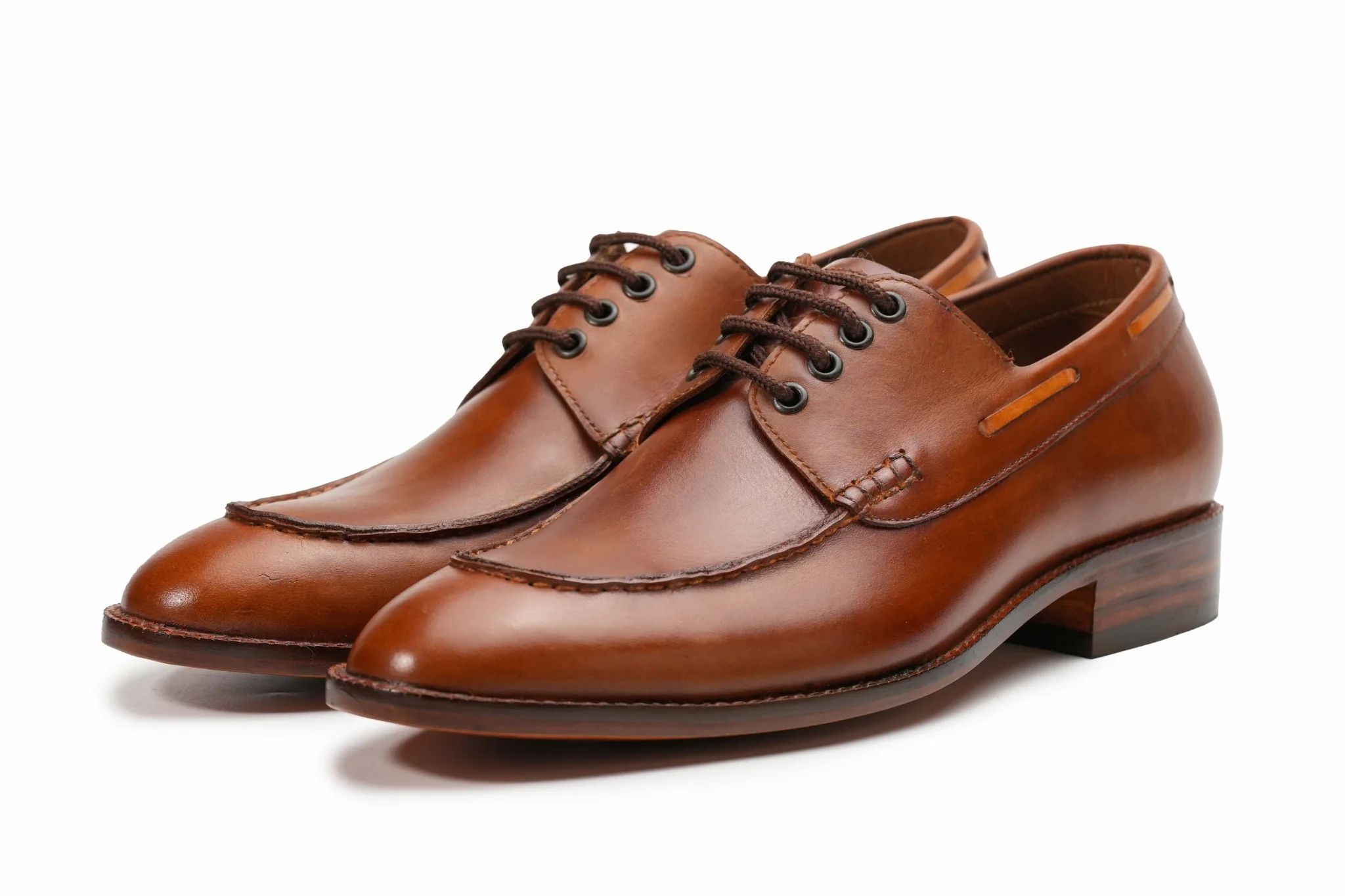
Closed lacing vs open lacing
This is the core distinction.
Balmoral / closed lacing
The facing is visually tighter and more integrated into the vamp.
When laced, the two sides usually sit close together.
That produces a cleaner line.
Derby / open lacing
The quarters sit above the vamp and can open outward.
That gives the foot more room to enter and more adjustment once the laces are tightened.

Why does lacing affect fit?
The last still determines the basic shape.
That means:
- toe geometry
- forefoot room
- instep volume
- waist
- heel direction
But the upper determines how easily the shoe can accommodate variation around that geometry.
A Derby’s open quarters can separate more over the instep.
A Balmoral’s closed architecture has less freedom to do that.
This does not mean:
Balmoral = narrow feet
and
Derby = wide feet
That would be too simple.
A Balmoral on a generous last may fit a broader foot better than a Derby on a narrow last.
The correct hierarchy is:
Last first.
Then:
Width.
Then:
Upper closure and adjustment.
Use the Sizing & Fit Guide to compare those variables together.
Which is better for a high instep?
The Derby generally gives you the more forgiving closure.
Its quarters can spread open farther over the instep before the laces are tightened.
That makes it easier to accommodate more volume.
Crockett & Jones notes that Derby open lacing is commonly suited to wider feet and higher insteps compared with closed-lacing Oxford construction.
But the last still matters.
A Derby built on low-volume geometry is not guaranteed to fit a high instep.
Likewise, a Balmoral built on an appropriate last may still work perfectly well.
If high instep is a known fit issue, compare last profile, product fit notes, available width and actual measurements.
Which looks more formal?
Usually the Balmoral.
Closed lacing creates a quieter and more controlled upper.
That is the same reason Oxford shoes generally sit above Derby shoes in traditional formality.
A dark Balmoral in smooth calf, particularly with a slim sole and restrained toe, can look almost like an Oxford shoe extended upward into a boot.
A Derby boot normally reads as somewhat less formal because the open quarters create more visible structure around the lacing.
That does not make it casual by default.
A refined black or dark-brown Derby boot can still work with tailoring.
Which works better with a suit?
For conservative tailoring:
Balmoral first.
The closed lacing and cleaner side profile sit naturally with structured trousers and formal clothing.
A Derby boot can also work with tailoring when the rest of the design stays refined.
The deciding factors include:
- smooth leather
- darker color
- restrained toe
- thinner sole
- minimal broguing
- elegant last
So the practical direction is:
formal suit → Balmoral
soft tailoring / flannel / smart casual → either
Which works better casually?
Derby boots usually have the easier path into casual clothing.
The open lacing already gives them a more relaxed visual vocabulary.
That works naturally with denim, chinos, cords, flannel trousers and casual jackets.
A Balmoral can still be dressed down.
But because the structure begins from a dressier place, the casual styling feels more deliberate.
If you want one lace-up boot to move easily between office and weekend wear, a Derby boot is often the simpler route.
Does Balmoral mean two-tone?
No.
Two-tone Balmorals are visually memorable, but contrast leather is not what defines the style.
The defining feature is closed lacing and the Balmoral upper architecture.
A Balmoral can be:
- all black
- all brown
- calf and suede
- two-tone
- plain
- brogued
- cap toe
So do not identify a boot as Balmoral merely because the shaft and vamp use different colors.
Look at the lacing structure.
Does a Derby boot need broguing?
No.
Broguing is decoration.
Derby is construction of the upper.
A Derby boot can be plain toe, cap toe, full brogue, wingtip or another pattern.
The same principle applies to Balmorals.
For a deeper explanation of broguing, read Brogue Shoes Explained.
Upper style and bottom construction are different
A Balmoral can potentially be built using different sole-construction systems.
So can a Derby boot.
That means:
Balmoral does not mean hand welted.
Derby does not mean Goodyear welted.
Closed lacing does not determine the outsole.
Open lacing does not determine repairability.
The boot’s family tells you how the upper is patterned and closed.
The product’s Materials & Construction specification tells you how the bottom is actually built.
For the bottom architecture, use Shoe Construction Explained.
Which is better for wide feet?
Do not decide from the family name alone.
The Derby’s open lacing can provide more adjustment over the instep.
That is useful.
But forefoot width still comes primarily from the last and available width.
Handsole uses D, E, EE and EEE where offered. Read Shoe Widths Explained if width is the real question.
What about comfort?
Neither boot is automatically more comfortable.
A Derby gives more closure adjustment.
A Balmoral gives a cleaner closed-lacing upper.
But comfort still depends on:
- correct length
- appropriate width
- last shape
- instep relationship
- upper leather
- lining
- insole
- outsole
- construction
A perfectly made Balmoral on unsuitable geometry can be uncomfortable.
A simpler Derby on the correct last can fit beautifully.
Which one should you choose?
Start with your foot and wardrobe.
Choose Balmoral if:
- you prefer closed lacing
- you want the dressier boot
- you frequently wear tailoring
- you like a clean Oxford-like upper
- your instep works well with the product’s last and fit
Choose Derby boot if:
- you want more opening and lace adjustment
- you have more instep volume
- you need a boot that moves easily into casual wear
- you prefer visible open-lacing structure
- versatility matters more than maximum formality
Then compare the actual product.
Do not stop at the category name.
How Handsole approaches Balmoral and Derby boots
Handsole lists Balmoral and Derby Boot separately within its Boots architecture.
That category tells you the upper family.
The product page remains responsible for:
- last
- US size
- width
- upper leather
- lining
- outsole
- construction
A Balmoral article should explain closed lacing.
It should not silently claim that every future Balmoral product is hand welted, leather soled or built on one particular last.
A Derby guide should explain open lacing.
It should not silently turn every Derby boot into a rubber-soled casual boot.
Common questions
Is a Balmoral boot basically an Oxford boot?
Yes, in the sense that both use closed-lacing architecture.
Is a Derby boot just a Derby shoe with a taller shaft?
It uses the same open-lacing principle, although boot patterns and proportions introduce their own design considerations.
Are Balmoral boots formal?
They are among the dressier traditional boot styles, particularly in dark smooth leather with restrained detailing.
Are Derby boots casual?
Not necessarily. A refined Derby boot can work with tailoring, but open lacing generally makes it easier to dress down than a Balmoral.
Are Derby boots better for wide feet?
They may give more adjustment over the instep, but actual forefoot width still depends on the last and width option.
Can Balmoral boots have broguing?
Yes. Broguing is decoration and does not change the basic closed-lacing architecture.
Same boot height, different architecture
Balmoral and Derby boots can occupy similar space in a wardrobe.
Both give you ankle coverage.
Both can use fine leather.
Both can be made dressy.
But the upper is built around two different ideas.
Balmoral: closed lacing, cleaner line, more formal starting point.
Derby: open lacing, more adjustment, more versatile starting point.
Neither system replaces the need to evaluate the actual shoe.
After choosing the style, ask:
Which last is underneath it?
Which width is available?
What leather is being used?
What outsole does it have?
How is the bottom constructed?
Because the boot family explains the architecture.
The product specification tells you whether that particular boot belongs on your foot.