What Shoes to Wear With a Navy Suit — Black, Brown, Burgundy & More
A navy suit can work with black, brown and burgundy shoes. The best pairing depends on how formal the event is and how much contrast you want.
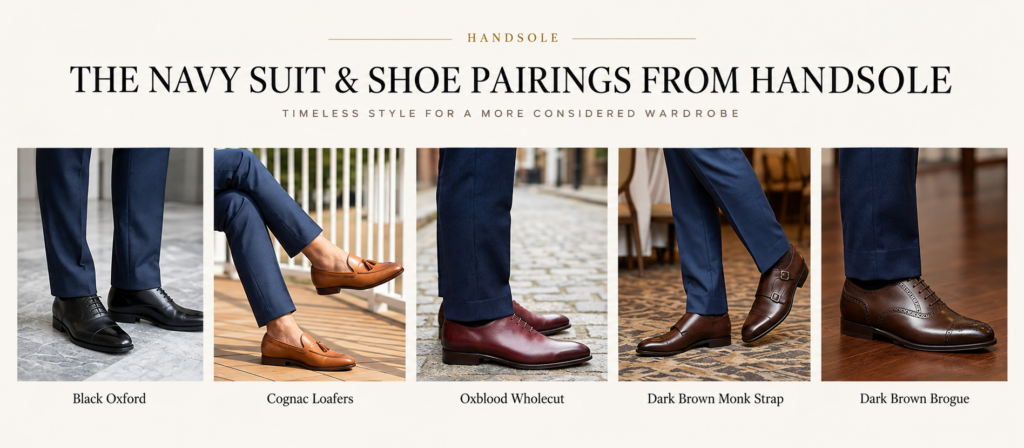
Black, dark brown and burgundy shoes can all work with a navy suit. Black is a restrained choice for conservative business or more formal presentation. Dark brown adds warmth and serves many business and social outfits. Burgundy introduces a richer alternative when the setting permits a little more colour.
Choose the shoe’s style and finish alongside its colour. A dark smooth Oxford and a chunky suede loafer do not produce the same result, even if both suit the navy palette. This guide explains the main options, separates office tailoring from specific evening dress, and helps you coordinate the whole outfit without unnecessary matching rules.
1. Establish the occasion and the suit
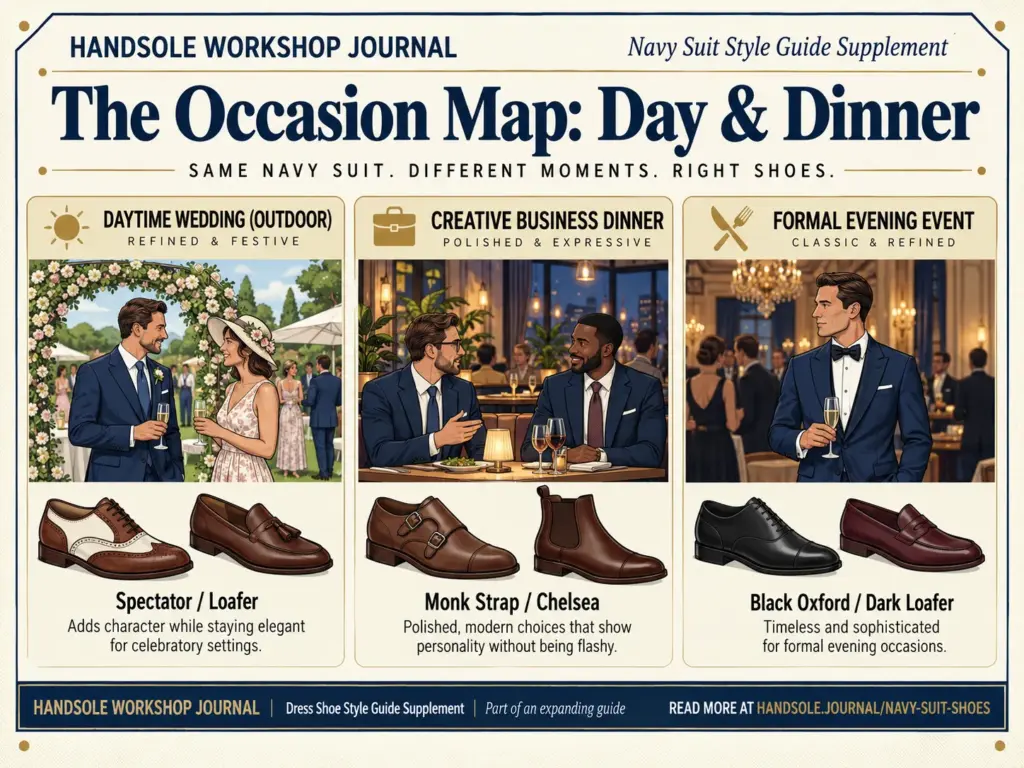
A navy suit can be conservative business clothing, relaxed summer tailoring or a social-event outfit. The cloth, cut and occasion change what footwear makes sense. A fine dark worsted suit for a formal meeting generally supports more restrained shoes than a textured navy suit worn with an open-collar shirt at a relaxed dinner.
Start with the dress requirement. If your office or event specifies conventional formal footwear, follow that guidance. If the setting is flexible, colour and texture become tools for personal preference. The suit’s navy colour does not grant every shoe equal suitability; the full design and occasion remain important.
Very dark navy can appear almost black in some light. Black shoes provide a quiet transition, while dark brown adds a subtle contrast. A brighter blue suit makes the contrast more apparent and can support a different social impression. Evaluate the actual cloth in ordinary light rather than using the word navy as a precise colour measurement.
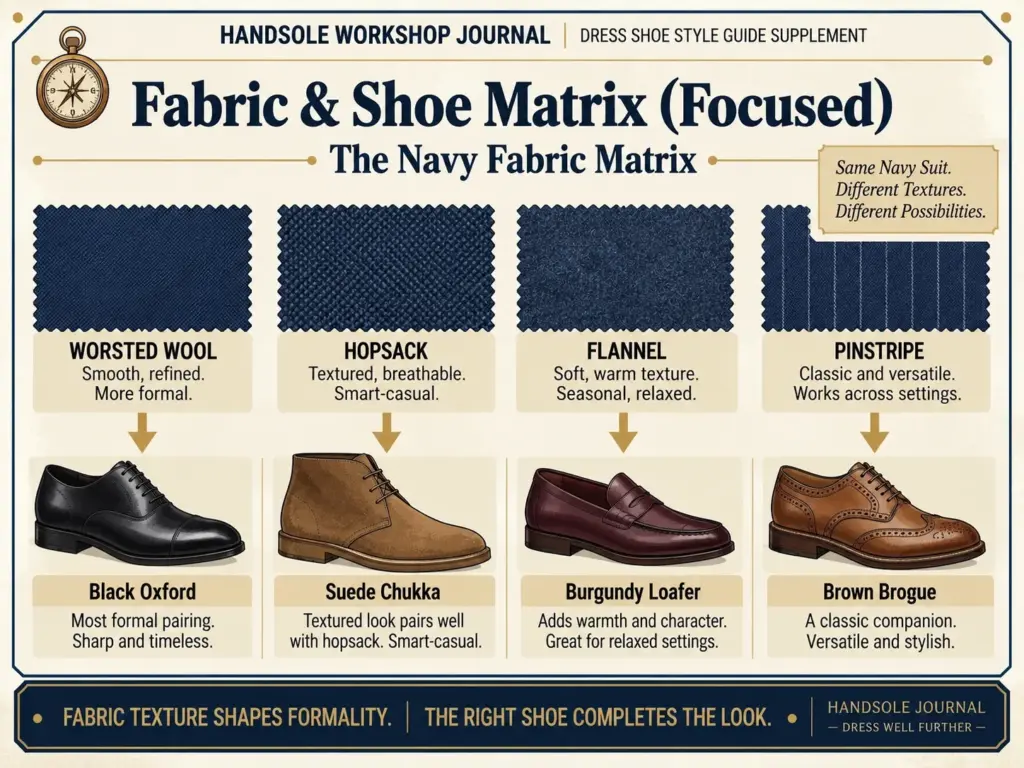
Surface matters too. Fine smooth cloth often works best with comparably restrained footwear. A textured wool suit can accommodate suede or a more relaxed upper in the right setting. Linen or a lightweight casual suit may support loafers more naturally. These are editorial judgments about coherence, not fixed rules about the materials themselves.
| Situation | Useful colour starting point | Useful shoe character |
|---|---|---|
| Conservative business meeting | Black or restrained dark brown where accepted | Simple smooth leather lace-up |
| Everyday office with flexible tailoring | Dark brown, black or muted burgundy | Neat Derby, Oxford, monk or suitable loafer |
| Relaxed social event | Brown or burgundy | Style and texture matched to the suit |
| Textured casual navy suit | Dark brown, including suede | Restrained relaxed shoe or boot |
| Specific formal evening convention | Follow the stated dress requirements | Do not infer suitability from navy alone |
A useful purchasing question is which occasion you face most often. If the suit is mainly for conservative work, start with the footwear that reliably meets that need. An expressive second option can then broaden the wardrobe. Buying only for an imagined relaxed event may leave the most common requirement unresolved.
Our broader guide to black versus brown shoes compares their wardrobe roles. Here the key is to choose colour within the suit’s actual context rather than treating navy as a reason to buy every possible shade.
2. Compare black, brown and burgundy
Black smooth leather is the quietest conventional choice for many formal business combinations. It creates a controlled contrast with navy without introducing a warm accent. A restrained black Oxford is a useful starting point when you want the outfit to look serious and uncomplicated. The shoe’s condition still matters: dull damage or neglected edges can undermine an otherwise appropriate selection.
Black is not restricted to black suits. With navy, it can look especially coherent alongside a white shirt, restrained tie and simple accessories. Avoid trying to warm the outfit artificially if your goal is a cool, formal palette. A black shoe’s usefulness follows the overall presentation rather than a prohibition against mixing dark colours.
Dark brown
Dark brown is a versatile alternative where brown footwear is accepted. It provides warmth while remaining comparatively restrained. A smooth dark brown lace-up can serve office and social tailoring; a suede loafer shifts the same colour toward a more relaxed impression. Compare material and style alongside shade rather than assuming every dark brown shoe occupies the same role.
Mid-brown and chestnut create more noticeable contrast. They can be attractive with navy, but they place more emphasis on the footwear. Crockett & Jones’ chestnut-calf styling article offers a primary maker example of this colour relationship. It is useful context, not a universal dress-code ruling.
Tan creates the strongest light-dark contrast among these common browns. It can suit relaxed social tailoring, but it is not the easiest default for a conservative office. If the shoes become much brighter than every other part of the outfit, decide whether that focus is intentional. A darker brown may give you broader everyday use.
Burgundy and oxblood
Burgundy can add depth beside navy without the brightness of light tan. However, colour names vary: some pairs are nearly dark brown with a red undertone, while others are visibly wine-coloured. Assess the actual shade and finish. A restrained dark burgundy shoe is different from a vivid red patina even when product names place them in a similar family.
Keep surrounding accents controlled when the shoes provide colour interest. A burgundy tie need not match exactly, and it is not required. A white or pale blue shirt with a quiet tie can leave the shoe as the main warm accent. Repeating strong colour in several places may be more conspicuous than the setting warrants.
For a first suit shoe, choose the option that meets your regular requirements rather than the most unusual finish. Black or dark brown often provides a useful foundation. Burgundy becomes especially valuable when it adds a distinct role to a wardrobe already supported by the basics.
3. Select the style and sole profile
A restrained Oxford is a conventional starting point for business tailoring. Its closed-lacing pattern can produce a neat upper, but toe shape and decoration still vary. A simple dark pair and a heavily brogued two-tone model do not have identical formality. Our Oxford and Derby comparison explains the actual pattern difference.
A neat Derby can work with many navy suits, particularly in everyday business or flexible social settings. Open lacing does not automatically make it unsuitable for tailoring. Inspect the entire shoe: a controlled sole and restrained upper may fit the outfit better than a much more elaborate Oxford.
Monk straps and loafers
A monk strap introduces hardware and a more visible fastening arrangement. It can provide a considered alternative with navy tailoring where the setting permits it. Keep buckle size and surrounding accessories in mind. A highly polished double monk with prominent hardware draws more attention than a simple lace-up.
A loafer can work with relaxed navy tailoring, especially an open-collar shirt, knitwear or a textured suit. A polished dark leather model is generally easier to dress up than a soft casual suede version. Do not assume that any loafer is acceptable for a conservative meeting simply because another model was styled with a suit.
The practical differences are covered in monk strap versus loafer. For a suit, appearance and fit both matter. A slip-on that does not hold the foot securely or a buckle that compresses the instep is not made suitable by a flattering colour combination.
Boots
A restrained Chelsea can work with navy business or social tailoring, provided the trouser opening falls cleanly over the shaft. See Chelsea boots with a suit for that proportion check. A substantial casual boot introduces more visual weight and needs an outfit that supports it.
The outsole’s profile matters more to appearance than a simplistic leather-versus-rubber rule. A discreet rubber sole can work with tailoring, while a thick leather sole can still look substantial. Separately evaluate performance for your expected conditions. Neither material label proves universal comfort, grip or water resistance.
Try the selected shoes with the actual trousers. Toe shape, sole weight and trouser opening combine to form the lower silhouette. A suitable colour can still look awkward if the trousers pool heavily over the upper or appear too narrow for the shoe. Small proportion changes often improve the outfit more than adding another accessory.
4. Coordinate socks, belt and other details
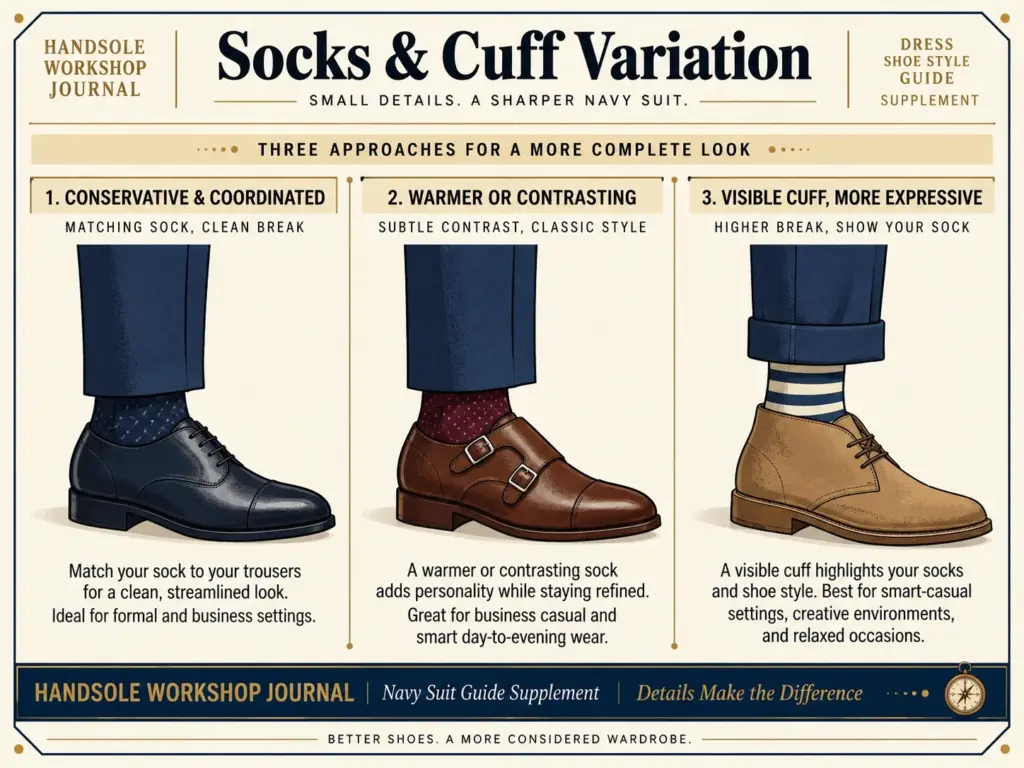
Navy or another suitably dark sock close to the trouser colour creates a quiet transition. That is an easy starting point for business tailoring. A sock related to the shoe colour can also work, while a deliberate muted pattern may suit a flexible setting. The important check is how the sock appears when you sit, not just when the trousers cover it.
Use the sock thickness that fits your footwear and intended use. Switching to a thick sock purely for colour can change the fit; a very thin sock can reveal looseness in a pair fitted with more bulk. The outfit should be built around a wearable combination rather than treating socks as a purely decorative afterthought.
Belts need compatibility, not exact duplication
A black belt is a simple companion to black shoes, and a broadly compatible brown belt can connect brown shoes with the suit. Exact shade matching is unnecessary, especially with patina or burgundy. Texture, width and buckle restraint also influence the result. A casual belt in the perfect colour may be less suitable than a refined one that is slightly different.
If the trousers use braces or have no belt loops, there is no need to add a belt to repeat the footwear colour. Let the garment’s design guide the accessory. Matching rules are tools for coherence, not reasons to introduce items the outfit does not require.
Shirts and ties
A white shirt provides a clean base for black, brown or burgundy shoes. Pale blue can make the navy outfit feel a little softer. Strong patterns and vivid ties introduce additional accents, so consider how many features compete for attention. If the shoes have a dramatic patina, quieter details above may make the overall effect more controlled.
Do not assume that brown shoes require a brown tie or burgundy shoes require a wine-coloured pocket square. Broad harmony is more useful than literal repetition. Navy, white and one restrained warm accent can be enough. A coherent outfit can contain several colours without turning every accessory into a matched set.
Presentation and condition
Clean footwear, an appropriate polish and tidy sole edges help the outfit look considered. The right maintenance method depends on the leather and finish. Our care-product guide explains why cream, wax and conditioner serve different purposes. A highly reflective finish is optional; a clean moderate shine may suit the outfit better.
Inspect the suit and shoes together in ordinary light. Dark indoor lighting can conceal colour differences, while bright product photography can exaggerate them. The complete outfit should work where you will wear it, including the view when sitting and walking. That practical trial is more reliable than judging separate online images.
5. Make a useful purchase decision
If you need one pair for a navy suit, list the actual occasions: office days, interviews, weddings, dinners or presentations. Choose for the most frequent and demanding requirement. A restrained black or dark brown pair often covers a substantial range, but your dress policy and other clothing determine which is more useful.
For a second pair, add a different role rather than a nearly identical colour. Burgundy may offer social variety, a suede loafer may support relaxed tailoring, or a suitable boot may serve a seasonal silhouette. Avoid buying several conspicuous pairs before securing the footwear needed for your ordinary business occasions.
Are black shoes wrong with navy?
No. They are a conventional, restrained choice for many navy-suit outfits. The shoe should still suit the event and the suit’s character. A rugged black casual shoe is not made formally equivalent to a simple Oxford by its colour. Black provides a useful palette option, not automatic approval for every design.
Are brown shoes acceptable for a wedding?
They can be appropriate with a navy suit when the event’s dress requirements allow the combination; our men’s wedding shoes include brown and black options. Consider the ceremony’s formality and any stated instructions. A wedding is not one uniform dress category. If specific formal evening dress is requested, follow that convention rather than general advice about business suits.
Can I wear sneakers with a navy suit?
That can be a deliberate relaxed styling choice where the occasion permits it, but it is a different presentation from conventional business footwear. Check the event or workplace requirements first. Do not treat acceptance in one creative office or social setting as a general rule for interviews, ceremonies or formal meetings.
Should I choose tan for maximum versatility?
Not automatically. Tan creates a pronounced contrast with navy and may be less useful in conservative settings. Dark brown can provide a quieter bridge across office and social outfits. Compare the colours against the trousers you actually own, including grey or black if relevant, rather than judging versatility from one navy outfit.
What if my shoes fit differently from sneakers?
Use the maker’s sizing guidance and a real trial. Our dress-shoe and sneaker sizing guide explains why a blanket size conversion is unreliable. An appropriate suit shoe still needs room for the toes, compatible instep hold and sensible heel control. Appearance should follow a sound fit.
Navy is adaptable, but the best shoe choice is specific. Match the occasion, choose the amount of colour contrast you want, and confirm style, proportions and fit in the complete outfit. That produces a more useful result than treating one shoe colour as correct for every navy suit.